
Americans spend an average of $300–$600 on portable air purifiers each year — between the device itself and recurring filter replacements — yet most report no lasting improvement in their indoor air quality, according to Consumer Reports. The device runs, the fan spins, and the symptoms that triggered the purchase remain: morning headaches, persistent allergies, stuffy rooms that never feel fresh. The problem is not the purifier. It is that a tabletop device cannot fix a system-level issue.
On AllBetter
Need a local pro?
Post the job free and compare bids from identity-verified local pros — payment held in escrow until the work is done right.
Find a verified pro near you →Average spent on portable air purifiers and filters
Indoor air pollution vs. outdoor (EPA)
Conditioned air lost through leaky ducts
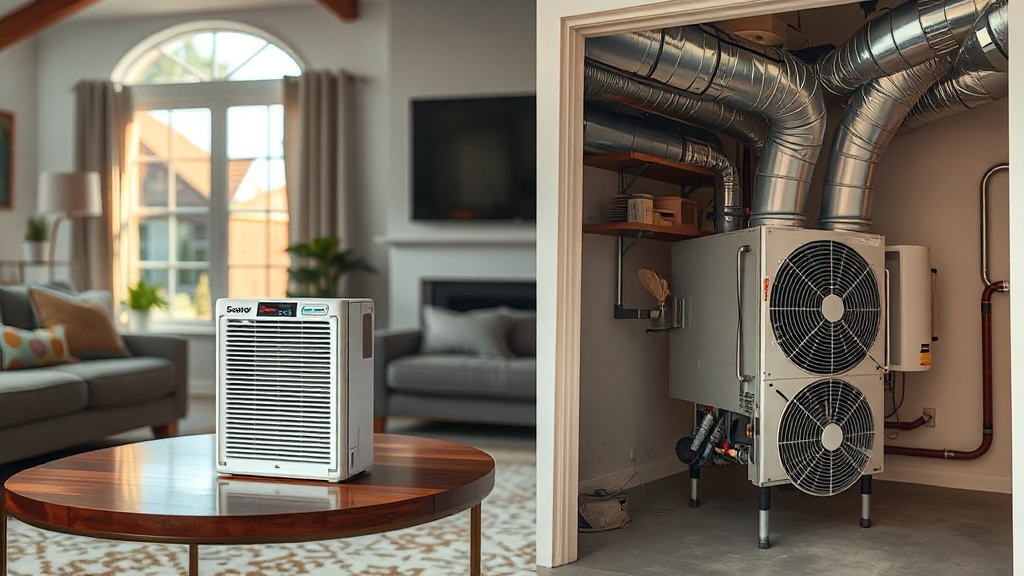
What is the difference between an air purifier and a whole-house system? A portable air purifier filters air in a single room (typically 200–400 square feet) using an internal fan and HEPA filter. A whole-house air quality system integrates directly into your HVAC ductwork to filter, humidify, dehumidify, and ventilate every cubic foot of air in the entire home. The portable unit treats symptoms in one space; the whole-house approach addresses the root cause across all rooms.
This guide explains why most air purifiers disappoint, which whole-home services actually improve indoor air quality, and how to determine which approach — or combination — makes sense for your home.
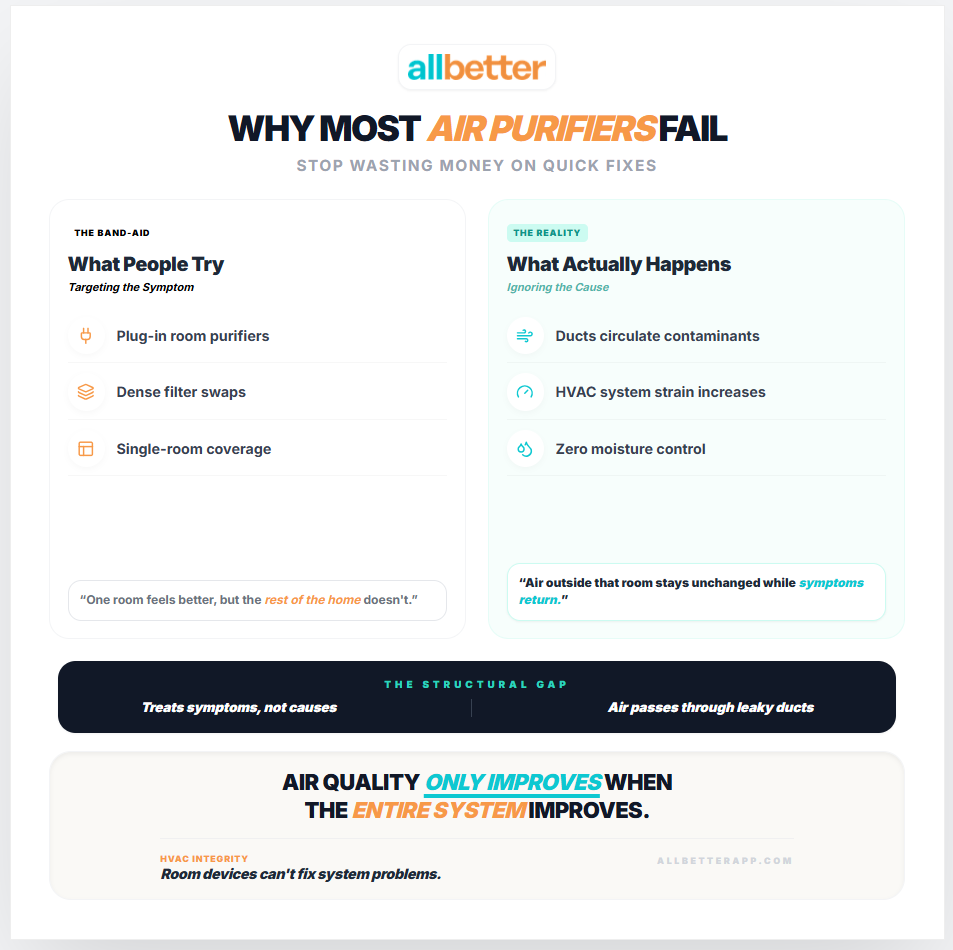
Why Indoor Air Quality Is a System Problem, Not a Device Problem
Skipping the DIY route? You can post the job on AllBetter and have ID-verified pros bidding in about 10 minutes — no spam calls, payment held in escrow until you approve the work.
Your home acts like a sealed container. Air circulates through the same ductwork again and again — through return vents, filters, coils, and supply registers. If those ducts are dirty, leaky, or humid, the air never improves no matter how many purifiers you plug in.
The EPA estimates that indoor air is two to five times more polluted than outdoor air. But that pollution does not come from a single source. It comes from the interaction of multiple systems: HVAC filtration, humidity control, ventilation, and duct integrity. A portable purifier addresses one room’s particulates while ignoring the ductwork pushing contaminated air into every other room.
The EPA reports indoor air contains 2 to 5 times more contaminants than outdoor air — and Americans spend 90% of their time indoors.
True air quality depends on four factors
- How air enters the system (returns and fresh air intakes)
- How it gets filtered (HVAC filter type and condition)
- How moisture is controlled (humidity levels)
- How stale air leaves the house (ventilation)
That requires services and system upgrades — not gadgets.
The MERV Rating Trap: Why Better Filters Can Damage Your HVAC
Filters are rated using MERV (Minimum Efficiency Reporting Value). Higher numbers catch smaller particles. But higher is not always better — and this is where well-intentioned homeowners cause expensive damage.
What goes wrong with high-MERV filters
Very dense filters restrict airflow through the HVAC system. When airflow drops, the blower motor works harder. Coils freeze or overheat. Energy bills climb. Equipment life shortens. According to the American Society of Heating, Refrigerating, and Air-Conditioning Engineers (ASHRAE), installing a filter with a MERV rating that exceeds your system’s capacity can reduce airflow by 20–30 percent and increase energy consumption by 10–15 percent.
The practical sweet spot
- MERV 8–11: Works for most residential HVAC systems. Captures dust, pollen, mold spores, and pet dander without restricting airflow.
- MERV 13+: Only appropriate for systems specifically designed for high-static-pressure filtration. Most standard residential units cannot handle this density.
- Thicker media filters (4–5 inches): Provide better filtration than dense thin filters because the deeper media bed allows more airflow while trapping more particles.
A qualified HVAC technician can test your system’s static pressure and recommend the highest-rated filter your equipment can safely handle. If allergies are severe, upgrading the system is the right approach — not forcing a denser filter into hardware that was not built for it.
Humidity Control: The Line Between Comfort and Mold
Mold needs moisture to survive. Keep indoor humidity below 50 percent, and mold struggles to colonize. Let humidity drift above 60 percent consistently, and mold growth becomes almost inevitable — regardless of how clean your air filters are.
The EPA identifies excess indoor humidity as one of the leading causes of poor air quality in residential homes. No portable air purifier addresses humidity. That requires system-level intervention.
Why humidity drifts out of range
- Summer moisture enters through cracks, windows, and foundation seams
- Bathrooms and kitchens add water vapor daily
- Basements trap cool, damp air that circulates upward
- Winter heating dries air excessively, causing respiratory irritation
What actually fixes it
- Whole-home dehumidifier ($1,500–$2,500 installed): Integrates with HVAC ductwork. Removes 70–100 pints per day. Essential in humid climates.
- Whole-home humidifier ($400–$1,000 installed): Adds moisture during dry winter months. Prevents cracking wood floors, static, and respiratory irritation.
- Hygrometer ($10–$30): A basic digital humidity monitor placed in the living area and basement tells you exactly where your levels stand.
Humidity balance protects lungs, hardwood floors, furniture, and drywall. It is one of the most overlooked home maintenance tasks — and one of the cheapest to monitor once you have the right equipment in place.
Leaky Ducts: You May Be Breathing Attic Air
On AllBetter
Ready to get it done?
Fund escrow before work starts. Release payment when you approve the finished work.
Find a verified pro near you →Return ducts pull air back into the HVAC system for recirculation. If those ducts have gaps, cracks, or disconnected joints, they pull air from spaces never meant to be breathed: attics full of insulation fibers, crawlspaces with moisture and pest debris, wall cavities with accumulated dust.
According to the Department of Energy, the average home loses 20–30 percent of its conditioned air through duct leaks. That means you are paying to heat and cool air that never reaches your living spaces — and replacing it with unfiltered contaminants.
Why duct sealing matters
- Keeps filtered air inside the delivery system
- Reduces allergens and particulates dramatically
- Improves HVAC efficiency by 20–30 percent
- Lowers energy bills
- Extends equipment life
Professional duct sealing costs $1,000–$3,000 depending on home size and duct accessibility. It is one of the highest-impact home maintenance investments available — yet most homeowners never consider it because the ducts are hidden from view.
Carbon Dioxide Buildup in Modern Tight Homes
Newer homes built to modern energy codes exchange very little air naturally. That energy efficiency comes with a trade-off: rising indoor CO2 levels that cause headaches, fatigue, difficulty concentrating, and a persistent “stuffy” feeling even when the air smells clean.
ASHRAE recommends a minimum ventilation rate of 0.35 air changes per hour for residential spaces. Many modern homes fall well below this threshold without mechanical ventilation.
Duct-integrated air quality solutions reduce airborne particulates by 50–85% across the entire home, per the Department of Energy.
The solution: energy recovery ventilation (ERV)
An ERV system brings fresh outdoor air into the home while simultaneously exhausting stale indoor air — and it transfers heat and moisture between the two streams so you are not wasting energy. ERVs cost $1,500–$3,500 installed and are particularly valuable in tightly sealed homes built after 2010.
Portable Purifiers vs. Whole-Home Solutions: Side-by-Side Comparison
| Approach | Coverage | Cost | Result |
|---|---|---|---|
| Plug-in HEPA purifier | One room | $100–$300 + filters | Temporary, localized |
| High-MERV filter swap | Whole system | $15–$40 per filter | Risky if system not rated |
| Duct sealing | Whole home | $1,000–$3,000 | High impact, permanent |
| Humidity control | Whole home | $400–$2,500 | Preventive, health-focused |
| ERV ventilation | Whole home | $1,500–$3,500 | Long-term, energy-smart |
Air quality improves when the system improves. Portable units have their place — a bedroom purifier for a child with severe asthma makes sense as a complement to whole-home solutions. But as a standalone strategy, they are insufficient. If you are also dealing with water-related air quality issues, our guide on spotting water damage early covers how moisture problems affect the air you breathe.
Air quality is a system job — price it right
Post the job once and identity-verified pros send real bids — compare prices side by side, and your payment sits in escrow until you approve the finished work.

The 4-Step Indoor Air Quality Assessment
Before spending money on any air quality solution, diagnose the problem first:
- Test humidity levels. Place a hygrometer in your main living area and basement. If readings consistently exceed 50 percent or drop below 30 percent, humidity control is your first priority.
- Check your HVAC filter. Pull it out and inspect it. If it is clogged, check the MERV rating against your system’s specifications. Replace on schedule (every 1–3 months for 1-inch filters, every 6–12 months for 4-inch media filters).
- Inspect accessible ductwork. Look for visible gaps, disconnected joints, or dust streaks at duct connections. These indicate leaks pulling unfiltered air into the system.
- Schedule a professional assessment. A qualified HVAC technician can test static pressure, measure airflow, check for duct leaks, and recommend the right combination of filtration, humidity control, and ventilation for your specific home.
Stop Guessing — Find a Verified HVAC Pro Near You
AllBetter connects you with experienced local HVAC professionals who can inspect ducts, adjust filtration, manage humidity, and improve ventilation. Post your air quality concern, receive bids from verified contractors, and compare pricing — all with escrow payment protection.
AllBetter connects you with experienced local HVAC professionals who can inspect ducts, adjust filtration, manage humidity, and improve ventilation. Post your air quality concern, receive bids from verified contractors, and compare pricing. One limitation worth noting: AllBetter is a newer marketplace, so availability of HVAC specialists varies by region. In areas with limited coverage, your local utility company or HVAC manufacturer can often provide referrals.
For a broader look at keeping your home’s systems in shape, our free home maintenance planner includes seasonal HVAC checkpoints that help you catch air quality issues before they become expensive problems.
Hire an ID-verified home services pro — without the lead-gen markup
| Feature | Angi / Thumbtack / HomeAdvisor | AllBetter |
|---|---|---|
| Pro Identity Verified | Self-attested, no verification | Stripe Identity verification on every pro |
| Lead Fees to Pros | $15–$80 per lead (passed back to homeowner) | only pay when you win — ever |
| Payment Protection | None — you pay direct, hope for the best | Escrow Shield — you only release payment when work is approved |
| Pro Quality Filter | Anyone can sign up; reviews come later | ID-verified pros, average 3+ bids per job |
| Spam & Auto-Calls | Your phone rings for days after one inquiry | Zero spam — pros message in-platform |
Lead-fee context: home services leads on traditional platforms run $20-$80 each — that markup gets baked into your quote.
DIY-ing home services work without an ID-verified pro can turn a $200 fix into a $2,000 do-over — and the quality issues only show up months later. The safer move is to post the job on AllBetter — you get ID-verified bids in minutes, no obligation.
Your money sits in escrow and is released only when you approve the work.
Frequently Asked Questions
Why does my air purifier stop working after a few weeks?
Portable air purifiers treat air in a single room while your HVAC system continues circulating contaminated air through the entire house. If the root cause is leaky ducts, high humidity, or poor ventilation, the purifier cannot keep up. It is not that the device stopped working — it is that it was never able to address the underlying system problem.
What MERV rating should I use for my home HVAC filter?
MERV 8–11 works for most residential systems. Higher ratings (MERV 13+) restrict airflow in standard equipment and can cause coil freezing, motor strain, and higher energy bills. ASHRAE recommends having a technician test your system’s static pressure before upgrading to ensure compatibility. Thicker 4–5 inch media filters outperform dense thin ones.
Is a whole-house air purifier better than a portable one?
For whole-home coverage, yes. A whole-house system integrates into your HVAC ductwork and filters all circulating air — not just one room. Portable units work best as supplements for high-priority spaces like bedrooms. The Department of Energy reports that duct-integrated solutions reduce airborne particulates by 50–85 percent across the entire home.
How much does it cost to improve whole-home air quality?
Costs depend on which services your home needs. Duct sealing runs $1,000–$3,000. Whole-home dehumidifiers cost $1,500–$2,500 installed. ERV ventilation systems range from $1,500–$3,500. A proper HVAC filter upgrade is $15–$40 per replacement. Most homes benefit from a combination of two or three of these services rather than a single solution.
Does duct sealing really improve air quality?
Yes. The Department of Energy estimates that the average home loses 20–30 percent of conditioned air through duct leaks. Sealing those leaks stops unfiltered attic air, crawlspace moisture, and insulation fibers from entering your breathing air. It also improves HVAC efficiency and lowers energy bills, making it one of the highest-return home improvements available.
What humidity level should I maintain indoors?
The EPA recommends keeping indoor humidity between 30 and 50 percent. Below 30 percent causes dry skin, respiratory irritation, and static buildup. Above 50 percent promotes mold growth, dust mite reproduction, and wood warping. A $10–$30 digital hygrometer placed in your main living area and basement provides continuous monitoring.
When should I call an HVAC professional for air quality issues?
Call a professional if you experience persistent allergy symptoms indoors, musty odors that do not resolve with cleaning, humidity levels consistently above 50 percent, visible dust buildup at vent registers, or uneven temperatures between rooms. These symptoms indicate system-level problems that require professional diagnosis — not another portable purifier.
More AllBetter resources: