
AllBetter Field
Run a home-service business?
AllBetter Field keeps quotes, jobs and invoices in one app, starting at $29/mo with no lock-in. Team scheduling and dispatch are on Pro and up.
See AllBetter Field →Most new landscaping businesses fail not because the owner cannot cut grass, but because they spend half their revenue on fuel, equipment payments, and chasing unpaid invoices — the predictable result of scattered routes, underpriced contracts, and no system for recurring billing.
How do you start a landscaping business that actually makes money? Build it on three rules: route density (minimizing drive time between properties), recurring subscription billing (so you never chase a payment), and disciplined equipment scaling (buying only when demand proves it). A lean residential operation can launch for roughly $3,000–$5,000 in total startup capital — equipment, insurance, and registration combined.
Why Most Landscapers Stay Broke
AllBetter Field
Ready to ditch the paperwork?
See how AllBetter Field keeps your quotes, jobs and invoices in one place. Starting at $29/mo; team dispatch is on Pro and up.
See AllBetter Field →A $50 lawn sounds profitable until you map the time. Thirty minutes driving there, 45 minutes mowing, 30 minutes to the next property — that “$50 lawn” took nearly two hours before fuel, truck wear, and taxes. At that rate, an 8-hour day yields four to five lawns and grosses $200–$250 — below minimum wage in most states after expenses.
The trap compounds because scattered clients feel like growth. Ten clients across a 30-mile radius looks like a real business on paper; in reality it is a delivery service with a mower in the back. Drive time is the most expensive line item in the trade, and landscaping — with its frequent short visits — is the most exposed trade of all. Scattered routes also wear tires, brakes, and trailers far faster than a tight loop.
Route Density: The One Rule That Determines Profit
Route density means working multiple properties in the same area, back-to-back, with minimal drive time between each. If you cannot see your next property from your current one, your pricing barely matters — drive time erases the margin no matter what you charge. The math is counterintuitive but consistent:
- Lawn A: $50, 20 minutes away → about $25/hour effective rate after drive time.
- Lawn B: $40, next door → about $48/hour effective rate with no drive time.
Lower price, higher profit. This single principle separates landscaping businesses that scale from ones that stall. Density also cuts fuel costs, slows equipment wear, and reduces the fatigue that limits how many properties you can service in a day.
How to Build Route Density From Scratch
New landscapers waste money advertising across a whole city, which only produces scattered clients and empty hours between them. The proven approach is geographic:
- Pick one neighborhood. Choose a residential area with 200+ homes, consistent lot sizes, and visible demand — overgrown lawns, unmulched beds.
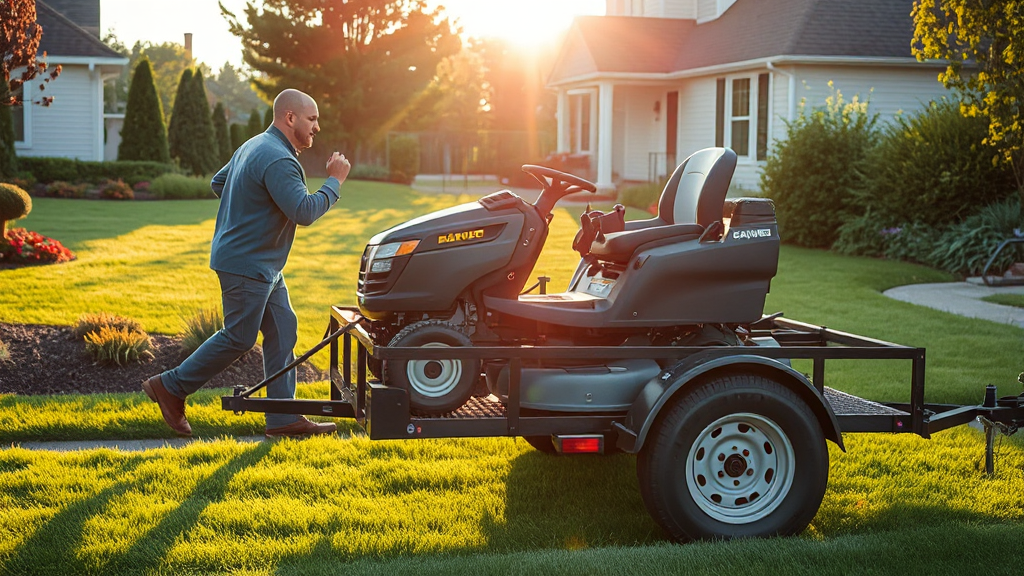
- Complete one lawn visibly. Trailer parked on the street, crew working efficiently, property looking sharp when finished.
- Knock on the next three doors. Offer weekly service on your existing route day at a competitive rate, noting you will already be in the neighborhood.
- Stack the route. Every new client on the same street adds revenue without adding drive time. Four lawns on one street out-earn eight scattered across town.
The Equipment Ladder: Don’t Buy Toys Before Demand
Financing a $10,000–$12,000 zero-turn mower on day one is the most common startup mistake. That payment forces you to accept bad jobs at bad prices just to cover the note — the equipment owns you. Buy used first; commercial mowers, trimmers, and trailers regularly sell well below retail. The smart path scales equipment with demand:
Upgrade only when the time saved exceeds the payment. If a mower will not pay for itself in saved hours within six months, it is a liability, not an upgrade. The same discipline applies to starting any contracting business with no experience: let demand fund growth, not debt.
Landscaping Is a Subscription Business — Treat It Like One
Grass grows every week, so recurring revenue is built into the trade — the most valuable model in field services. Yet most new landscapers bill like freelancers: one-off invoices, inconsistent timing, and awkward payment talks that wreck cash flow. The non-negotiable billing rules:
- Card on file from day one. No exceptions. A client who will not give payment information upfront will be difficult to collect from later.
- Weekly or bi-weekly automatic billing. The card is charged after each service. No envelopes, no follow-ups, no “I’ll pay you Friday.”
- Subscription framing. Sell “weekly lawn care,” not individual cuts. Monthly pricing of $160–$200 for weekly service feels more manageable than $40–$50 per visit — and gives you predictable revenue to plan around.
Automating that billing cycle is exactly where the right contractor efficiency software pays for itself, removing the manual invoicing that quietly eats an evening every week. Our comparison of the best lawn care business software shows which tools list recurring billing and service contracts.
Mowing Pays the Bills — Add-Ons Create Profit
Weekly mowing keeps the lights on and holds your route together. The real margins come from upselling work you spot while already on a property — no extra drive time. High-margin add-ons:
You do not need to hard-sell — just point out what you notice: “Your mulch is getting thin, want me to refresh it next visit?” Recurring property access builds trust, and trust leads to higher-value work. Over time, average revenue per client can climb into the $250+/month range with add-ons, at zero additional acquisition cost.
Insurance, Licensing, and Legal Basics
Before your first paying client, protect the business with general liability insurance — typically $400–$800 a year for a solo landscaper. It covers property damage (a rock thrown by a mower through a window) and bodily-injury claims. Most residential clients never ask for proof, but commercial properties and HOA contracts require a certificate of insurance before approving any vendor.
Registration rules vary by state and municipality. At minimum, register a business name, get a free EIN from the IRS (about 10 minutes online), and check whether your county requires a business license or permit. Some states require a landscaping contractor license above a dollar threshold — California, for example, requires a C-27 license for projects over $500. Check your state’s contractor board before bidding.
Frequently Asked Questions
How much money do I need to start a landscaping business?
Plan on $800 to $1,500 for basic equipment — a commercial push mower, trimmer, and blower — plus $500 to $1,000 for insurance and business registration. Avoid financing expensive equipment until demand proves it. Keeping cash reserves for roughly three months of expenses puts realistic total startup capital at $3,000 to $5,000.
Should I charge per visit or monthly?
Monthly subscription billing of $160 to $200 a month for weekly service is strongly preferred. It creates predictable revenue, simplifies accounting, and increases retention because clients see a maintenance plan rather than a series of transactions.
How many clients do I need to make a full-time income?
With tight route density and weekly service, 25 to 30 recurring clients at $40 to $50 per visit generate $4,000 to $6,000 a month in gross revenue. After fuel, insurance, and equipment costs, a solo operator typically nets $3,000 to $4,500 a month. Add-ons lift that further without adding clients.
What is more important — price per lawn or route density?
Route density wins every time. A $40 lawn next door to your last client is more profitable than a $60 lawn 20 minutes away. Drive time is unpaid work and mowing is paid work, so minimize the former and maximize the latter. Every client on a tight route raises your effective hourly rate.
Is landscaping seasonal? How do I handle winter?
In most regions, mowing season runs March through November. Winter options include snow removal, leaf cleanup, holiday lighting installation, and maintenance planning. Some landscapers use year-round subscription pricing that averages the seasonal variation, banking the premium from active months to cover the slowdown.
What is the best way to find my first landscaping clients?
Door-to-door in one targeted neighborhood is the fastest and cheapest method. Complete one lawn visibly, then knock on neighboring doors, offering competitive weekly rates and noting that you will already be in the area. This builds route density from day one. Supplement it with a Google Business Profile to capture inbound demand.