

On AllBetter
Need a local pro?
Post the job free and compare bids from identity-verified local pros — payment held in escrow until the work is done right.
Find a verified pro near you →You bought 25 leads from Angi last month at $60 each. That’s $1,500 out of pocket before you walked into a single job. You won 4 of them — typical 16% win rate. The math nobody on Angi’s homepage shows you: those 4 jobs cost you $375 each in lead fees alone, before you bought a tube of caulk, before you fueled your truck, before you paid yourself an hour of labor. The lead-gen platforms call this a “marketing investment.” The accounting calls it the Lead-Gen Tax — money you pay before the work, on a 1-in-5 chance the work happens at all. It’s the most expensive marketing channel in home services, and the one most pros enter through assuming it works like advertising. It doesn’t. It works like a per-shot lottery ticket where you’ve also paid four other operators to play the same number. This article gives you the calculator that shows your real cost-per-won-job — and what the same volume looks like on a completion-only fee model. The math is below. The structural argument follows.
Rent vs Result — the structural fee difference
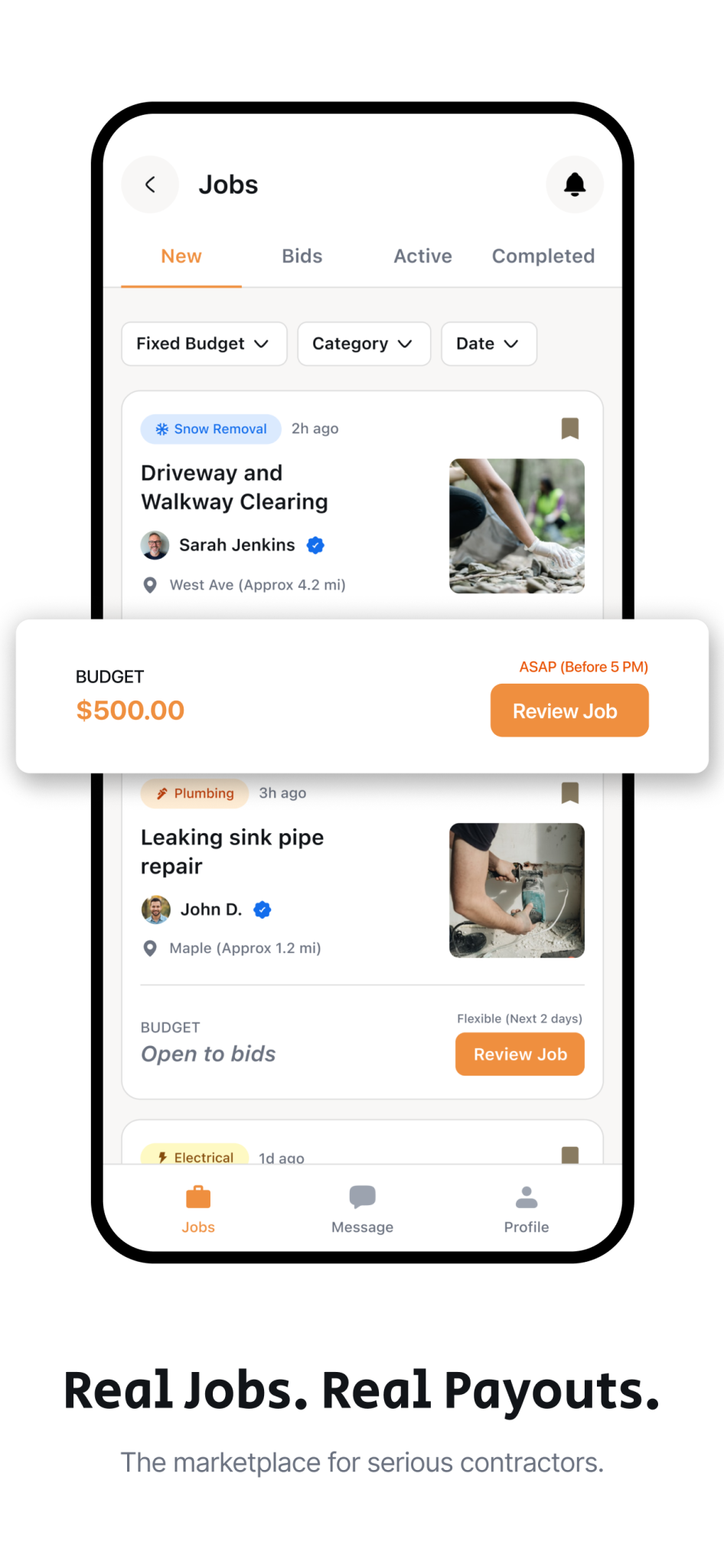
Tired of renting leads? On AllBetter JobPro you bid on real local jobs and pay a small fee only when you win the job and the invoice is paid — never per lead, and never for a shared lead you lose.
Once the math is visible, the Rent versus Result distinction becomes structural rather than philosophical. Lead-gen aggregators charge Rent — you pay to access leads regardless of whether you win the work. AllBetter charges Result — no fee to bid, and a small fee only when you win the job and the invoice is paid. The fee is paid only after the work is done and the customer has confirmed completion. Same job volume, different cost structure, different impact on your hourly take-home.
Why plumbing leads cost $50–$80 and cleaning leads cost $15–$25
The pricing differential between service types tracks the average ticket size of the underlying job, not the difficulty of generating the lead. Aggregators price-discriminate by vertical: a plumbing job that often runs $400–$2,000 generates a lead worth $50–$80 to them because they know the operator can absorb that cost from a single won transaction. A cleaning job that runs $150–$400 supports a $15–$25 lead price for the same reason — the per-job revenue caps what the aggregator can charge before the operator’s economics break. HVAC sits at the high end of the range because emergency HVAC repair tickets routinely run into four figures, and full system replacements push five. The aggregator knows this. So the lead price is set as a fraction of expected ticket value, not as a fraction of marketing cost. That’s price discrimination by service vertical — perfectly rational from the aggregator’s side, devastating to the operator’s margin, and the contractor-side analog of why cleaning quotes vary by 150 percent on the homeowner side. The fact that you’re paying $60 per lead doesn’t mean Angi spent $60 generating that lead. They spent a few dollars on Google ad clicks, paid SEO, and content. The $60 is what the market will bear, calibrated to your service ticket — and you’re competing for the lead with 4 other operators who all paid the same.

Why win rate is the variable that breaks operator economics
The most-quoted statistic on lead-gen platforms is conversion rate (“our pros win 1 in 5 leads”). The reality across the operator base runs lower than the marketing copy. Industry observation puts the realistic win rate at 11–20% — better operators close 1 in 5, average operators close 1 in 8, and slower-responders or higher-priced bidders end up at 1 in 9 or worse. The math at each tier is unforgiving. At 1 in 5 (20% win rate) on $60 leads, your cost-per-won-job in lead fees is $300. At 1 in 8 (12.5%) it’s $480. At 1 in 9 (11%) it’s $540. Same lead price, same lead volume — the difference between “this is profitable” and “this is bleeding you” is the win rate. And the win rate isn’t fully under your control. It depends on response time, bid pricing relative to the other 4 operators, the customer’s actual job-readiness, and luck. The aggregator absorbs none of this risk. They get paid the same $60 whether you win or lose. Your $300–$540 cost-per-won-job is the operating leverage they extracted from the model — it’s not a bug, it’s the design.
The AllBetter alternative — pay on Result, not on Rent
On AllBetter
Ready to get it done?
Fund escrow before work starts. Release payment when you approve the finished work.
Find a verified pro near you →AllBetter’s structural answer to the Lead-Gen Tax is straightforward: eliminate the upfront fee. Operators on AllBetter pay nothing to see a job posted, nothing to bid on it, and nothing if they don’t win the work. When they do win, a small fee applies on the completed, paid transaction — and it is all-in: it covers card processing, the platform, the escrow service, and marketplace operations. There are no separate line items eating margin. Translated into the operator’s per-job math: there is no fee to bid, and the fee on a won job is proportional to the job, only paid on Result, and only after the customer has confirmed completion through the escrow release. Set that against the lead-gen side of this article, where the same cleaning, plumbing, and HVAC jobs each start with a $15–$80 lead purchase whether or not the operator wins the work. Compared to lead-gen aggregators — and franchise platforms like those documented in Who Owns Mr. Rooter? The 17-Brand KKR Plumbing Empire — where the cost is extracted regardless of outcome, the math flips at almost every revenue level. The structural answer is that operators absorbing $300–$540 per won job in lead fees on Angi-style aggregators are paying 2–3× more than the same volume on a completion-only model.
Red Flag / Green Flag — read your platform’s fee structure honestly
Three minutes with the platform’s fine print tells you whether the fee model is Rent or Result. The signal is in what you pay before a job is won versus what you pay after.
| 🔴 Rent model (Angi / Thumbtack / HomeAdvisor) | 🟢 Result model (AllBetter / JobPro) |
|---|---|
| Pay per lead even if you don’t win | $0 to see a job |
| Pay per bid submitted (some platforms) | $0 to bid |
| Same lead sold to 4–5 other operators | 3 verified bidders per job, no resale |
| Subscription required to access the platform | No subscription, no access fee |
| Fee charged regardless of completion | A small fee on the completed transaction only, after escrow release |
| Credit card processing + platform fee + add-ons billed separately | One all-in fee: covers processing, platform, escrow, operations |
Three operator scenarios — what the math looks like at scale
Three typical operator profiles below show what the Lead-Gen Tax actually costs at each volume — plug your own numbers into the math to project your specific scenario. Solo cleaner, 25 leads/month at $20/lead, 16% win rate, $200 avg job: $500 monthly lead spend, 4 jobs won, $125 cost-per-won-job in lead fees. On AllBetter the same operator pays nothing for those 25 leads and a small fee only on the 4 jobs won, so most of that $500 stays in the business. Mid-size plumbing shop, 30 leads/month at $65/lead, 14% win rate, $475 avg job: $1,950 monthly lead spend, 4.2 jobs won, $464 cost-per-won-job. On AllBetter the same shop pays nothing for those 30 leads and a small fee only on the 4.2 jobs won, so most of that $1,950 stays in the business. Two technicians’ worth of net margin compression — gone to lead fees. HVAC contractor, 40 leads/month at $75/lead, 13% win rate, $1,200 avg job: $3,000 monthly lead spend, 5.2 jobs won, $577 cost-per-won-job. Same volume on AllBetter = $180 per job, $936 monthly. The Lead-Gen Tax costs this contractor $2,064/month or about $24,800/year. That’s a service tech’s salary, paid to Angi instead of to a person doing the work — the contractor-side mechanic of the same financial structure documented in The Homeowner’s Field Guide to the Roll-Up Scam.
Hire an ID-verified home services pro — without the lead-gen markup
| Feature | Angi / Thumbtack / HomeAdvisor | AllBetter |
|---|---|---|
| Pro Identity Verified | Self-attested, no verification | Stripe Identity verification on every pro |
| Lead Fees to Pros | $15–$80 per lead (passed back to homeowner) | only pay when you win |
| Payment Protection | None — you pay direct, hope for the best | Escrow Shield — you only release payment when work is approved |
| Pro Quality Filter | Anyone can sign up; reviews come later | Only ID-verified pros, average 3+ bids per job |
| Spam & Auto-Calls | Your phone rings for days after one inquiry | Zero spam — pros message in-platform |
Lead-fee context: home services leads on traditional platforms run $20-$80 each — that markup gets baked into your quote.
DIY-ing home services work without a ID-verified pro can turn a $200 fix into a $2,000 do-over — and the quality issues only show up months later. The safer move is to post the job on AllBetter — you get ID-verified bids in minutes, no obligation.
Your money sits in escrow and is released only when you approve the work.
How AllBetter changes the math beyond the fee structure
The pay-only-when-you-win fee is the headline, but three additional structural advantages compound the savings: bidding pool integrity (3 verified pros per job, no lead resale to operators outside the platform), payment certainty (escrow holds the customer’s payment until job confirmation, eliminating chase-the-invoice cycles), and platform-level marketing (AllBetter’s own brand growth drives demand to the marketplace, so operators don’t carry the customer-acquisition cost on top of the platform fee). For operators evaluating a switch, the test isn’t “is AllBetter perfect?” — every platform has tradeoffs. The test is whether the fee structure aligns with how money actually moves in your business. Money moves on completed jobs, not on lead receipts. Fee structures that charge on completed jobs align with operator cash flow. Fee structures that charge on leads received do not.
Start bidding on JobPro — no fee to bid, pay only when you win
Free download: The Lead-Gen Tax Spreadsheet — 12 months of your real cost-per-won-job — track your monthly numbers, see the trend, decide on the data.
By Tarik Khribech, Founder of AllBetter. CS Master’s. Building the marketplace where operators pay on Result, not on Rent.
One more dimension: voice search makes the lead-fee tax even harder to hide. When Alexa picks one plumber to read aloud, the contractor who paid $40 for the lead can’t pad the quote across 5 competing bids — the homeowner sees the inflation directly.
And one tier worse than the lead-gen tax: the AI contractor scam category, where the contractor doesn’t exist at all — bot-built website, AI-generated reviews, deposit collected, contractor disappears.
And one parallel inflation tax: Apex’s brand premium is a different version of the same homeowner tax — instead of $40-per-lead pricing, Apex builds the markup into the underlying quote.
And one parallel inflation tax: Blackstone’s $2.5B Champions Group acquisition compounds the homeowner-side tax differently from lead-gen aggregators — instead of $40-per-lead pricing, the 18× EBITDA financing math gets baked into the underlying quote.
The inputs behind this calculator are attributed industry figures — the full verified breakdown, including Angi’s 10-K revenue math and the FTC’s 2023 order, is in what contractor leads really cost in 2026.
And one parallel handyman lens: flat-rate vs hourly handyman pricing shows how margin gets hidden differently in each billing model — same dynamic as lead-gen fees getting baked into the underlying quote.
One high-AOV inflation example: 2026 kitchen replacement quotes from PE-owned brands typically run 30-50% above independent local quotes for identical scope — same dynamic as lead-gen tax, scaled to $35K-$80K project sizes.
One specific install-quote scenario: heat pump water heater 2026 — the 30-50% PE-owned-plumbing-brand premium on a $5,000 install equals $1,500-$2,500 of pure financing markup, similar to the lead-gen tax dynamic.
One specific install scenario: whole-house generator cost — a $15K Generac install carries $4,500-$7,500 of PE-roll-up brand markup if quoted by an Apex/Champions/Mr. Rooter portfolio brand.
One tree-services lens: tree removal cost variance can run 2-4× for identical scope — making the lead-gen tax dynamic compound with the existing pricing-variance category in tree work.
One specific recurring service where lead-gen tax compounds: septic tank pumping — at $300-$700 per service every 3-5 years, the $40 lead-gen markup is significant on a small-ticket recurring service.
According to BLS — Occupational Outlook Handbook, BLS: home services demand continues to grow; quality + identity verification are the homeowner’s only baseline filters.
More AllBetter resources: