
Don’t want to DIY? Skip the lead-gen markup — post the job on AllBetter and get ID-verified bids in minutes. $0 lead fees, Escrow Shield on every transaction.
Looking for more jobs? Stop paying for leads. On AllBetter, homeowners post jobs and you bid direct — $0 lead fees, ever.
Get jobs on AllBetter →Organic channels matter more once you see what contractor leads really cost when you buy them outright.
The average HVAC contractor spends $3,000 to $8,000 per year on social media marketing and generates zero trackable leads from it. BrightLocal reports that 78% of consumers research local service providers online before making contact — but the content most HVAC companies post (clean equipment photos, “another install done” captions, and stock images of thermostats) gets scrolled past in under two seconds. The gap between spending on social media and earning from it comes down to one problem: HVAC businesses post content that makes them feel professional instead of content that makes homeowners feel uncomfortable enough to take action.
Check your inbox for a confirmation email.
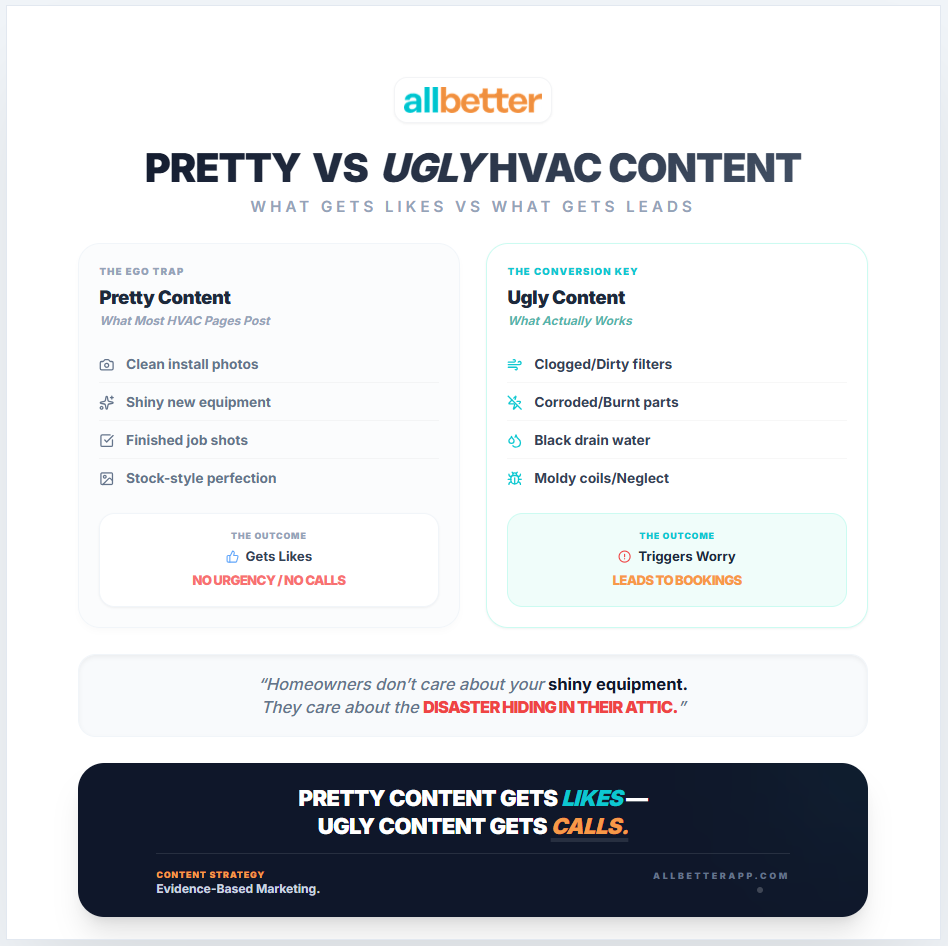
What kind of social media content actually generates HVAC leads? Content that shows problems — dirty filters, corroded wiring, mold-covered coils, clogged drain lines — outperforms polished installation photos by 3x to 5x in engagement and lead conversion, according to HubSpot’s local business marketing data. The reason is psychological: homeowners don’t schedule HVAC service because they saw a nice photo. They schedule because they saw something that might be happening inside their own system right now. Effective HVAC social media marketing pairs visual evidence of neglect with educational context and instant booking access, converting passive scrollers into scheduled service calls without requiring a phone conversation.
This guide covers the specific content strategies, platform tactics, local targeting methods, and conversion systems that turn HVAC social media from a time-wasting vanity project into a measurable lead generation channel.
Why Most HVAC Social Media Content Fails
Skipping the DIY route? You can post the job on AllBetter and have Stripe-verified pros bidding within the hour — no lead fees, no spam calls, payment held in escrow until you approve the work.
The typical HVAC social media post — a photo of a newly installed condenser unit with the caption “Another happy customer!” — fails for three specific reasons that have nothing to do with algorithm changes or posting frequency.
The three failure patterns:
- No scroll-stopping trigger: A clean piece of HVAC equipment looks like a beige metal box to a homeowner. It creates no curiosity, no urgency, and no emotional response. Social media feeds are saturated with polished images — another clean photo blends into the noise rather than interrupting it.
- No personal relevance: Installation photos say “look what I did.” Problem photos say “this could be happening in your house right now.” The second message creates action because the homeowner connects the content to their own situation. Sprout Social data shows that content triggering personal relevance generates 4x higher engagement than purely informational posts.
- No conversion path: A post that says “call us for a free estimate” fails because people scrolling social media at 9 PM are not going to pick up the phone. They need a tap-to-schedule option that captures the impulse before it fades — and most HVAC companies don’t offer one.
The Problem-First Content Strategy
The content that generates HVAC leads follows a consistent pattern: show a problem that homeowners can’t see in their own systems, explain why it matters, and provide an immediate way to schedule an inspection. Every piece of content should answer one question in the viewer’s mind: “What happens if I ignore this?”
High-performing HVAC content categories:
- Before-condition photos and videos: Dirty evaporator coils caked with dust and mold, air filters that are black instead of white, drain lines filled with sludge, corroded electrical connections. These images stop scrolling because they trigger a visceral response that polished photos never create.
- Cost-of-neglect comparisons: Side-by-side posts showing “Maintenance cost: $150” versus “Repair cost after skipping maintenance: $1,200.” These posts convert because they frame the service call as financial protection rather than an expense.
- Process videos: Time-lapse coil cleaning that shows the transformation from filthy to clean. Drain line flush videos showing black water turning clear. These demonstrate value visually without requiring any caption to explain what you do and why it matters.
- Educational warnings: Short explanations of common failures with real examples. “This capacitor failed because the homeowner skipped two years of maintenance. Replacement cost: $380. The annual tune-up that would have caught the swelling early costs $89.” This positions you as an expert through evidence, not claims.
HVAC contractors who build stable businesses through service agreements generate this content naturally — every tune-up and maintenance visit produces photos and videos that become next week’s social media posts without any additional production effort.
Platform Strategy: Where HVAC Content Actually Converts
Ready to fill your schedule? Join AllBetter and pick up local jobs near you — no lead fees, payment protection built in.
Get jobs on AllBetter →Not all social media platforms generate HVAC leads equally. The platform strategy should match where homeowners in your service area actually search for and discover local service providers.
| Platform | HVAC Lead Value | Best Content Type |
|---|---|---|
| Facebook (local groups) | Highest — local targeting | Before/after photos, educational warnings |
| Google Business Profile | High — search intent | Review responses, project photos, posts |
| Medium — visual discovery | Process videos, transformations, Reels | |
| TikTok | Low-Medium — younger demographic | Short process clips, “what went wrong” stories |
Facebook local groups produce the highest return for HVAC contractors because the audience is geographically targeted and actively discussing home maintenance. Posting helpful content (not advertisements) in neighborhood groups, community pages, and local homeowner associations builds recognition among people who live within your service area. BrightLocal reports that 87% of consumers read online reviews and social proof for local businesses — and local Facebook group activity functions as real-time social proof.
Google Business Profile posts are underutilized by most HVAC companies but appear directly in search results when homeowners search for HVAC service in your area. Weekly posts with project photos and seasonal maintenance reminders keep your profile active and visible in local search rankings.
Local Targeting: One Nearby Lead Beats a Thousand Distant Followers
Industry hashtags like #HVAClife and #HVACtech attract other HVAC technicians — not homeowners looking for service. Local targeting means every post, hashtag, and audience selection focuses on reaching people who live within your service radius.
Local targeting tactics that generate HVAC leads:
- Geographic hashtags: Use city, neighborhood, and county names rather than industry terms. #nationwide, #PlanoHomeowner, #CollinCountyHVAC reach people who could actually become customers.
- Facebook group participation: Join neighborhood groups, HOA pages, and local community boards in your service area. Provide helpful answers to HVAC questions (without hard-selling) and your name becomes familiar before homeowners even need service.
- Location tagging on every post: Tag the city or neighborhood where each project was completed. This associates your company with specific geographic areas in the platform’s algorithm and in homeowners’ minds.
- Seasonal local content: Post content timed to your region’s weather patterns — pre-summer AC preparation in April and May, heating system reminders in September and October. Seasonal content feels relevant because it matches what homeowners are experiencing right now.
HVAC businesses that stay prepared for peak demand can use social media during shoulder seasons to fill maintenance schedules — running inspection promotions targeting local audiences during the months when emergency call volume is low.
Converting Social Media Views Into Scheduled Service Calls
The highest-quality HVAC social media content in the world generates zero revenue if the conversion path requires a phone call. The SBA reports that 62% of small business leads generated through social media are lost because the business lacks an immediate response mechanism — the homeowner sees the content, feels motivated, but encounters a “call us” message and decides to handle it later. Later never comes.
Building a social media conversion system:
- Direct booking link in bio: Every social media profile should include a link to an online scheduling page where homeowners can request an inspection or tune-up without calling. This captures late-night and weekend impulse leads that phone-only systems miss entirely.
- Call-to-action on every post: Replace “Call us today” with a specific, low-commitment action: “Schedule a $89 system inspection — link in bio.” The specific price removes uncertainty, and the booking link removes friction.
- Automated response to inquiries: When someone messages your business page asking about service, an automated reply — “Thanks for reaching out! You can schedule service anytime at [booking link], or we’ll respond personally within 2 hours” — holds the lead until your team can follow up.
- Retargeting warm audiences: Facebook and Instagram allow you to create custom audiences of people who engaged with your content. Running low-budget ($5 to $10 per day) retargeting ads to these warm audiences with a seasonal offer converts at 3x to 5x the rate of cold advertising.
Mobile HVAC service software with online booking capabilities bridges the gap between social media content and scheduled service — allowing homeowners to convert from viewer to booked customer in under 60 seconds without requiring your team to answer a phone.
Content Calendar: What to Post and When
Consistency matters more than frequency. Three strong posts per week outperform daily posts of mediocre content. The content calendar should rotate through categories that each serve a different purpose in the lead generation process.
Weekly content rotation:
- Monday — Problem photo or video: Dirty filter, corroded part, clogged drain line. Caption explains what it is, what caused it, and what happens if it’s ignored. End with booking link.
- Wednesday — Educational tip or cost comparison: Seasonal maintenance reminder, energy savings data, or repair-versus-prevention cost comparison. Position yourself as the knowledgeable local expert.
- Friday — Transformation or customer story: Before-and-after process video, team photo on a completed project, or review screenshot with a brief thank-you. This builds trust and humanizes the business.
Every post should come from real projects — never stock images. Phone-quality video and photos outperform professionally edited content on social media because they feel authentic rather than corporate. Homeowners respond to evidence, not production value.
HVAC companies with strong subcontractor networks can encourage all technicians (both internal and subcontracted) to capture before-condition photos during every service call, creating a library of content that feeds the social media calendar without dedicated production time.
Measuring What Matters: Leads, Not Likes
Social media vanity metrics — likes, followers, and impressions — do not correlate with revenue for local service businesses. The metrics that matter for HVAC social media are direct lead indicators:
- Booking link clicks: How many people clicked through to your scheduling page from social media posts
- Direct messages requesting service: How many inquiries came through social media messaging
- Profile visits from local users: How many people in your service area viewed your business profile
- Cost per lead: If running paid promotions, total ad spend divided by number of leads generated — HVAC companies should target $15 to $40 per lead from social media
Track these monthly and compare against other lead sources. HVAC business management software with lead source tracking allows you to tag which customers found you through social media, measuring actual revenue generated — not just clicks and engagement. Teams that retain skilled technicians long-term build stronger local brand recognition because the same faces appear in social media content consistently, creating familiarity and trust with the local audience.
Frequently Asked Questions
Does showing ugly HVAC problems scare customers away?
No — it attracts the right customers. Homeowners who care about their property want honest information about what can go wrong, not polished marketing. Problem-focused content builds trust by demonstrating real expertise and showing exactly what your maintenance service prevents. The homeowners who are scared away by reality-based content were unlikely to invest in preventive maintenance regardless.
Do I need professional video equipment for HVAC social media?
No. A smartphone produces better-performing social media content than professional equipment for local service businesses. Authentic, slightly imperfect video feels real and trustworthy, while over-produced content feels like an advertisement that viewers scroll past. Focus on capturing genuine moments from real service calls — the content quality comes from what you show, not how you film it.
How often should HVAC businesses post on social media?
Three times per week is the minimum effective frequency for local lead generation. Posting less than twice weekly causes your content to disappear from followers’ feeds. Posting more than five times weekly rarely improves results and increases the risk of low-quality filler content. Consistency matters more than volume — three strong posts per week outperforms daily mediocre content.
Which social media platform generates the most HVAC leads?
Facebook, specifically local community groups and neighborhood pages. Facebook’s local targeting, group structure, and demographic profile (homeowners aged 30 to 65) align directly with the HVAC customer base. Google Business Profile posts are a close second because they appear in local search results when homeowners are actively looking for HVAC service.
How do I turn social media views into booked service calls?
Replace “call us” with a direct online booking link on every post and in your profile bio. The majority of social media engagement happens outside business hours when people won’t make phone calls. Online scheduling captures impulse leads 24/7, converting the urgency your content creates into scheduled appointments without requiring a conversation.
Should I show customer homes in social media content?
Show equipment only — never interior living spaces, addresses, or personally identifiable details. Focus the camera on the HVAC system, the filter, the coil, or the ductwork. This protects customer privacy while still providing the visual evidence that makes the content effective. Ask permission before posting any project-specific content, even equipment-only photos.
How much should HVAC companies spend on social media advertising?
Start with $150 to $300 per month on Facebook retargeting ads — targeting people who already engaged with your organic content. This warm audience converts at 3x to 5x the rate of cold audiences, making small budgets effective. Scale spending only after tracking cost-per-lead below $40. Organic content should remain the primary strategy, with paid advertising amplifying posts that already perform well organically.
Need related help? AllBetter also connects you with business software — ID-verified pros, $0 lead fees, payment held in escrow.
HVAC social-media leads convert at 1-3% on average — meaning 97-99% of your ad budget is wasted on people who never book. The smarter move is to AllBetter HVAC business software — ID-verified pros, transparent quotes, payment held in escrow until you approve the work.
No payment until you approve the work. Escrow Shield protects every transaction.
Why HVAC Businesses Choose AllBetter
| Feature | Angi / Thumbtack / HomeAdvisor | AllBetter |
|---|---|---|
| Pro Identity Verified | Self-attested, no verification | Stripe Identity verification on every pro |
| Lead Fees to Pros | $15–$80 per lead (eats your margin) | $0 lead fees — ever |
| Payment Protection | None — pay direct, hope for the best | Escrow Shield — release payment only when work is approved |
| Pro Quality Filter | Anyone signs up; reviews come later | ID-verified pros, average 3+ bids per job |
| Spam & Auto-Calls | Phone rings for days after one inquiry | Zero spam — pros message in-platform |
DIY-ing AC work without an ID-verified pro can turn a $200 fix into a $2,000 do-over — and the quality issues only show up months later. The safer move is to post the job on AllBetter — you get ID-verified bids in minutes, no obligation.
No payment until you approve the work. Escrow Shield protects every transaction.
Skip the DIY Risk
Don’t risk paying twice because the first contractor wasn’t checked out.
Post your job on AllBetter today. You don’t pay a dime until a Stripe-verified pro shows up, you approve in-app, Escrow Shield releases payment — backed by Escrow Shield.
Stripe-verified pros · $0 lead fees · Escrow Shield protection