

Looking for more jobs? Stop paying for leads. On AllBetter, homeowners post jobs and you bid direct — $0 lead fees, ever.
Stop chasing paperwork. Run the business side.
Field gives you scheduling, estimates, invoicing, and payment in one app — flat $29/month, no per-lead fees.
Check your inbox for a confirmation email.
Whatever software runs your crew, price it against headcount growth first — what field service software really costs has the published per-user math.
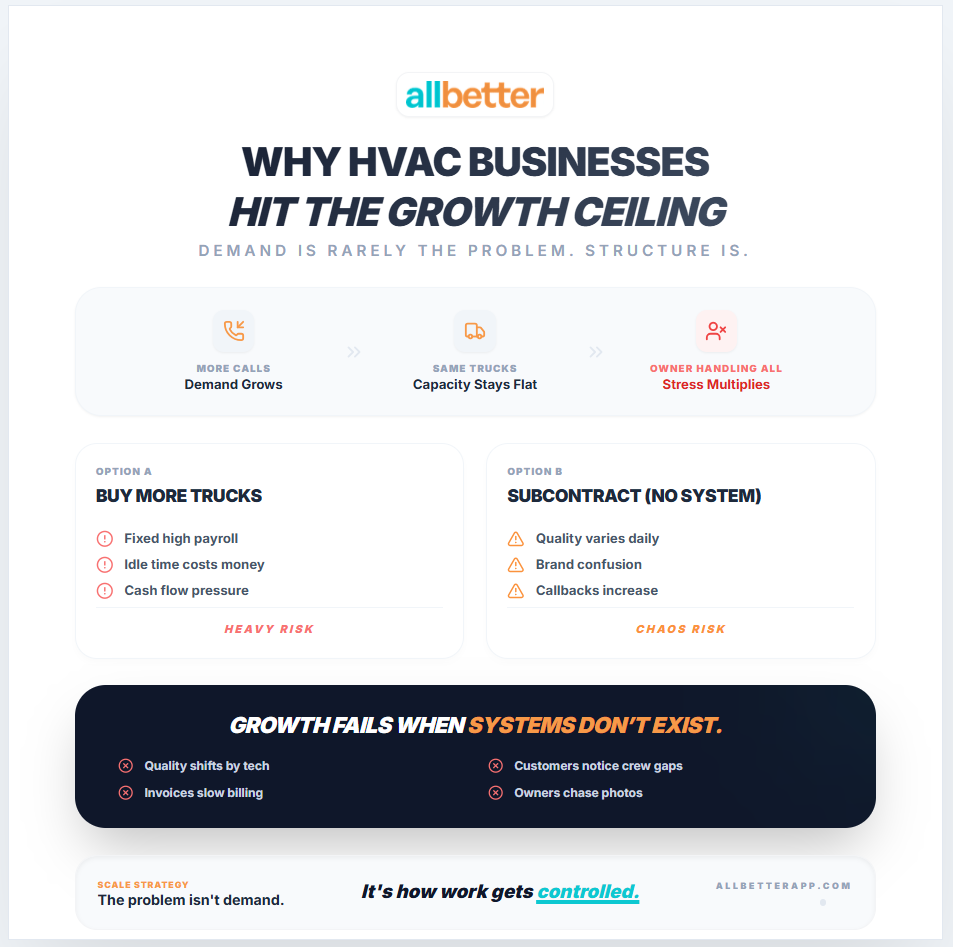
Adding a second truck to an HVAC operation costs $45,000 to $65,000 in vehicle purchase, tools, insurance, and fuel — before a single service call is completed. Adding a full-time technician to fill that truck adds $55,000 to $85,000 in annual salary, benefits, and workers’ compensation. The SBA reports that premature fleet expansion is one of the top causes of cash flow failure in home service businesses, because the fixed costs persist through slow months even when demand drops to a fraction of peak volume. An HVAC company running three trucks at 90% utilization in July often runs those same three trucks at 40% utilization in October — paying full insurance, full loan payments, and full wages on equipment and people generating half the revenue needed to cover them.
How do growing HVAC businesses scale without overcommitting to fixed overhead? Subcontractor partnerships allow HVAC companies to expand capacity during peak demand, accept overflow projects, and serve wider geographic areas without purchasing additional vehicles, carrying year-round payroll, or managing the insurance, training, and administrative costs of permanent employees. The key is operating subcontractors through documented systems — written agreements, photo verification, standardized workflows, and digital dispatch — rather than informal verbal arrangements that create quality inconsistencies, brand damage, and legal exposure. The IRS, state contractor licensing boards, and industry associations all emphasize that successful subcontracting depends on clear classification, defined expectations, and accountability structures that protect both parties.
This guide covers the operational framework for managing HVAC subcontractors effectively: when to use subcontractors versus employees, the white-label model that protects your brand, documentation systems that replace on-site supervision, payment structures that retain reliable partners, and the legal requirements that prevent misclassification penalties.
When Subcontractors Make Sense vs. When Employees Are Better
Ready to fill your schedule? Join AllBetter and pick up local jobs near you — no lead fees, payment protection built in.
Subcontractors and employees serve different operational purposes. Using the wrong model for the situation creates either unnecessary overhead or uncontrollable quality. The decision depends on work volume, consistency requirements, and financial risk tolerance.
| Factor | Full-Time Technician | Subcontractor |
|---|---|---|
| Best for | Consistent daily volume | Overflow and seasonal surges |
| Cost structure | Fixed (salary + benefits year-round) | Variable (pay per project only) |
| Control level | Full (schedule, methods, tools) | Limited (results, not process) |
| Risk during slow months | High (payroll continues) | None (no work = no cost) |
The NAHB recommends subcontractor models for HVAC companies experiencing seasonal demand swings of 40% or more between peak and off-peak months. When July requires five crews but October only needs two, carrying five full-time technicians through October means three crews generating cost without revenue. Subcontractors absorb the swing — available when needed, costing nothing when demand drops.
Full-time technicians make sense when daily call volume is consistent enough to keep crews productive year-round. HVAC companies with strong service agreement programs generating predictable monthly revenue can often justify larger permanent teams because the maintenance schedule fills shoulder-season gaps that would otherwise leave technicians idle.
The White-Label Model: Subcontractors Under Your Brand
White-label subcontracting means the homeowner never knows a third party performed the work. Your company name, your quality standards, and your reputation are what the customer experiences — regardless of which technician shows up. This model only works with documented standards that every subcontractor follows without exception.
Non-negotiable white-label requirements:
- Appearance standards: Plain vehicles or your company’s removable magnetic logos. Neutral clothing or your branded shirts. No personal business cards, no side conversations about “their company,” no visible competing branding at the customer’s property.
- Communication protocol: All customer communication flows through your office — not directly between the subcontractor and the homeowner. The customer called your company and expects your company to manage the project from scheduling through completion.
- Quality benchmarks: Written checklists for every service type — installation steps, pressure testing thresholds, refrigerant charge verification, electrical connection standards. The subcontractor follows your process, not their own preferred shortcuts.
- Non-compete clause: Standard subcontractor agreements include provisions preventing the sub from soliciting your customers directly for 12 to 24 months after the working relationship ends. This protects the customer relationships your marketing and reputation built.
Contractors who maintain professional preparation standards across both internal and subcontracted teams deliver consistent customer experiences that build referral networks regardless of which technician handles the call.
The Photo Gate: Documentation That Replaces Supervision
You cannot personally inspect every installation a subcontractor completes. You can require photographic proof of every critical step — creating an accountability system that catches problems before they become callbacks.
Required photo documentation before payment approval:
- Pre-work condition — existing equipment, access area, and any pre-existing damage documented before the subcontractor begins
- Critical installation steps — vacuum micron gauge readings below target, pressure test confirmations, proper line set routing, condensate drain connections
- Equipment identification — serial numbers on installed equipment matching the project specification, warranty registration cards completed
- Completed installation — clean final appearance, all panels secured, thermostat programmed, customer walkthrough completed
This is not a trust issue — it is a documentation standard. Professional subcontractors welcome photo requirements because the same documentation protects them from false callback claims. If a homeowner reports a problem six months later, the installation photos prove exactly what was done and how.
The BLS reports that callback rates in HVAC installation drop 35% to 45% when photo verification is required at each stage, because the documentation requirement forces technicians to verify their own work before submitting for approval.
Payment Structures That Retain Reliable Subcontractors
The most common reason good subcontractors stop accepting your work is slow payment. A skilled HVAC technician with their own license, tools, and insurance has options — and they will prioritize companies that pay predictably over companies that pay more but take 45 to 60 days to process invoices.
Payment structures that build loyalty:
- Net-7 or Net-14 payment terms: Pay within one to two weeks of verified project completion. Faster payment builds priority status — subcontractors accept your calls first when they know payment arrives quickly.
- Milestone payments for large projects: On multi-day installations, pay 50% at rough-in completion and 50% at final inspection. This keeps the subcontractor’s cash flow positive throughout the project rather than requiring them to float materials and labor costs until completion.
- Volume bonuses: Offer rate increases at volume thresholds — standard rate for 1 to 10 projects per month, 5% premium for 11 to 20, 10% premium above 20. This rewards loyalty without requiring emotional appeals.
- Clear rate cards: Publish fixed rates per service type so subcontractors know exactly what they will earn before accepting the assignment. Ambiguous pricing creates disputes that damage working relationships.
HVAC companies that combine reliable payment with consistent project volume and strong retention practices build subcontractor networks that function as reliably as internal teams — without the fixed overhead.
Legal Requirements: IRS Classification and Insurance
Misclassifying employees as subcontractors is one of the most common and costly mistakes in the trades. The IRS uses a behavioral control, financial control, and relationship test to determine classification — and the penalties for getting it wrong include back taxes, fines, and potential fraud charges.
Key classification rules:
- Behavioral control: You can define what result is needed but not how the subcontractor achieves it. Dictating specific work hours, requiring specific tools, or mandating specific methods may indicate employee status rather than contractor status.
- Financial control: Subcontractors should have their own business expenses, set their own rates (within your rate card), and have the opportunity to profit or lose on each project. Paying a fixed hourly wage with no project-based risk looks like employment.
- Insurance requirements: Every subcontractor should carry their own general liability insurance ($1 million minimum is standard for HVAC work) and workers’ compensation if required by your state. Request certificate copies before the first assignment — not verbal assurances.
Written subcontractor agreements should explicitly state the independent contractor relationship, define scope-based (not time-based) compensation, and include insurance verification requirements. The SBA recommends having these agreements reviewed by a business attorney familiar with your state’s contractor classification laws. Understanding the difference between estimates, quotes, and binding contracts applies equally to customer agreements and subcontractor agreements.
Dispatch Systems That Replace Micromanagement
Managing subcontractors through text messages, phone calls, and paper invoices works for two or three partners. It breaks completely at five or more. Digital dispatch systems handle the coordination that would otherwise require a full-time office administrator — assignment distribution, status tracking, photo collection, and payment processing.
What a subcontractor management system should handle:
- Project assignment and acceptance: Push assignments to available subcontractors with location, scope, rate, and required documentation — they accept or decline without a phone call
- Real-time status tracking: Know when the subcontractor arrives, begins work, reaches milestones, and completes the project without calling for updates
- Photo upload and verification: Required photos submitted through the platform before the project can be marked complete — no separate email threads or text messages
- Automated invoicing: Payment triggers automatically upon verified completion, eliminating manual invoice processing and reducing payment delays
Mobile HVAC service software allows subcontractors to manage their assignments from their phones — receiving project details, uploading documentation, and confirming completion without paperwork. Combined with structured scheduling systems, digital dispatch scales subcontractor networks from 3 partners to 15 without adding administrative staff.
Common Subcontracting Mistakes That Damage HVAC Businesses
The subcontractor model fails when contractors skip the operational framework and rely on informal arrangements. The most damaging mistakes are preventable with documented systems:
- No written agreement: Verbal arrangements provide no legal protection for either party and no basis for resolving disputes about scope, quality, or payment
- Paying before verification: Releasing payment without photo documentation removes the primary quality control mechanism and incentivizes rushing through projects
- Allowing mixed branding: Subcontractors displaying their own company branding at your customer’s property splits brand recognition and opens the door to direct solicitation
- Inconsistent volume: Calling subcontractors only during emergencies — rather than providing steady, predictable work — ensures they prioritize other clients who give them reliable income
- Skipping insurance verification: A subcontractor without adequate insurance exposes your company to liability for injuries, property damage, and faulty workmanship that their coverage should handle
Run your subs through one dispatch + payment workflow
| Feature | Angi / Thumbtack / HomeAdvisor | AllBetter |
|---|---|---|
| Pro Identity Verified | Self-attested, no verification | Stripe Identity verification on every pro |
| Lead Fees to Pros | $15–$80 per lead (passed back to homeowner) | $0 lead fees — ever |
| Payment Protection | None — you pay direct, hope for the best | Escrow Shield — you only release payment when work is approved |
| Pro Quality Filter | Anyone can sign up; reviews come later | Only ID-verified pros, average 3+ bids per job |
| Spam & Auto-Calls | Your phone rings for days after one inquiry | Zero spam — pros message in-platform |
Lead-fee context for this job type: subs paying lead fees on side-work get pulled away from your jobs — AllBetter routes work without that conflict.
Subcontractor confusion on a refrigerant changeover or a panel pull means callbacks, NATE-cert disputes, and EPA compliance gaps that trace right back to the GC. The safer move is to see AllBetter HVAC software — you get ID-verified bids in minutes, no obligation.
No payment until you approve the work. Escrow Shield protects every transaction.
Stop chasing paperwork. Run the business side.
Field gives you scheduling, estimates, invoicing, and payment in one app — flat $29/month, no per-lead fees.
Frequently Asked Questions
Is subcontracting HVAC work legal?
Yes. Subcontracting is standard practice in the HVAC industry for overflow capacity, specialized installations, and geographic expansion. However, subcontractors must hold their own licenses where required by state or local law, carry appropriate insurance, and be classified correctly under IRS guidelines. Check your state’s contractor licensing board for specific requirements regarding subcontracted HVAC work.
How do I prevent subcontractors from stealing my customers?
Include non-compete and non-solicitation clauses in your written subcontractor agreement — standard provisions prevent direct customer solicitation for 12 to 24 months. More importantly, provide consistent volume and fast payment. Subcontractors steal customers when work is sporadic and payment is slow. Make your company their most reliable income source, and poaching becomes an irrational business decision.
Should HVAC subcontractors carry their own insurance?
Yes — always. Require general liability insurance ($1 million minimum is industry standard) and workers’ compensation where applicable. Request certificate of insurance copies before the first assignment and verify coverage is current annually. Working with uninsured subcontractors exposes your company to liability for property damage, personal injury, and faulty workmanship claims.
What is the difference between a subcontractor and an employee for HVAC work?
The IRS distinguishes based on three factors: behavioral control (you define results, not methods), financial control (they bear business risk and expenses), and relationship type (no benefits, no guaranteed hours). Employees work under your direct supervision with your tools on your schedule. Subcontractors control how they complete the work, carry their own insurance, and invoice per project. Misclassification penalties include back taxes, fines, and potential fraud charges.
How do I maintain quality without being on every project site?
Implement photo gate documentation — required photographic proof of every critical installation step before payment is approved. Combined with written quality checklists for each service type, photo verification catches problems before they become callbacks. The BLS reports that callback rates drop 35% to 45% with documented photo verification systems.
How many subcontractors should an HVAC company maintain?
Maintain relationships with 2 to 3 subcontractors per service area beyond what your permanent team covers. This provides redundancy — if one is unavailable, others can accept the assignment. Too many subcontractor relationships with insufficient volume per partner creates loyalty problems. Focus on fewer partners with consistent work rather than a large network with sporadic assignments.
What payment terms keep HVAC subcontractors loyal?
Net-7 to Net-14 payment terms after verified project completion are industry best practice. Faster payment builds priority status — subcontractors accept your calls first when they know money arrives predictably. Volume bonuses at tier thresholds (5% premium above 10 projects per month, 10% above 20) reward loyalty through financial incentive rather than informal promises.
According to ACCA (Air Conditioning Contractors of America) — Quality Installation Standards, ACCA Standard 5 documents that 50%+ of HVAC installs fail at least one quality-installation criterion — sub oversight is the controllable factor.
More AllBetter resources you may find useful:
Skip the DIY Risk
Don’t risk a sub finishing the wrong scope while you’re tied up on a different call.
Post your job on AllBetter today. You don’t pay a dime until every sub job is scoped, dispatched, and signed off in-app — backed by Escrow Shield.
Stripe-verified pros · $0 lead fees · Escrow Shield protection
Related Reading: