
AllBetter Field
Run a home-service business?
AllBetter Field keeps quotes, jobs and invoices in one app, starting at $29/mo with no lock-in. Team scheduling and dispatch are on Pro and up.
See AllBetter Field →Carpet cleaning has a reputation as a crowded, low-margin trade — and for operators who chase $99 whole-house specials, it is. But run the numbers honestly and the picture changes. The trade still produces some of the strongest per-hour revenue in home services, if you price it correctly and resist the race to the bottom.
Is carpet cleaning still a profitable business? Yes. A solo operator running about three residential projects a day at $175–$275 each nets $125–$225 per project and can clear $97,500–$175,500 a year before taxes. Gross margins run 60–70% and net margins 30–50% — because chemical and equipment costs are tiny relative to what you charge.

The Real Profit Math Behind a Carpet Cleaning Project
AllBetter Field
Ready to ditch the paperwork?
See how AllBetter Field keeps your quotes, jobs and invoices in one place. Starting at $29/mo; team dispatch is on Pro and up.
See AllBetter Field →Most “is carpet cleaning profitable?” articles throw out revenue numbers without showing costs. Here is what an actual residential project looks like — a three-room job that takes one to two hours of work.
At three projects a day, five days a week, that is $1,875–$3,375 in weekly net profit — roughly $97,500–$175,500 a year before taxes. The margin holds because chemical costs are minimal and labor is typically just you, or you plus one helper. If you are still mapping out the wider operation, our definitive guide to starting your own cleaning business covers licensing, insurance, and setup step by step.
Why the “$99 Whole-House” Model Destroys Margins
Discount operators who advertise $99 whole-house specials rely on bait-and-switch upsells. The advertised rate is never the real price. That model creates three problems that compound:
- Clients feel deceived when the final bill is two to three times the advertised rate.
- Review scores tank — one-star reviews mentioning “hidden fees” kill future bookings.
- You attract price-shoppers who never rebook at full rates.
The profitable model is transparent pricing: $50–$75 per room, $25–$40 per hallway or staircase, with add-on pricing listed clearly. Clients who understand the price upfront rebook far more often than discount leads. Operators who fail at carpet cleaning are rarely losing to competition — they lose to their own pricing.
Carpet Cleaning vs. General House Cleaning
Carpet cleaning earns more per job than general house cleaning, but the two trades have different economics. A general house cleaner can run three to four jobs a day with minimal equipment. A carpet cleaner runs two to three but commands far higher revenue per hour.
Carpet cleaning’s real edge is resistance to margin compression. Anyone with supplies and a car can undercut a general house cleaner at $100 a clean. Carpet cleaning needs specialized equipment, product knowledge, and technique — a barrier to entry that keeps pricing power intact even in competitive markets. The smartest operators run both: general cleaning for recurring revenue, carpet cleaning as the high-margin anchor.
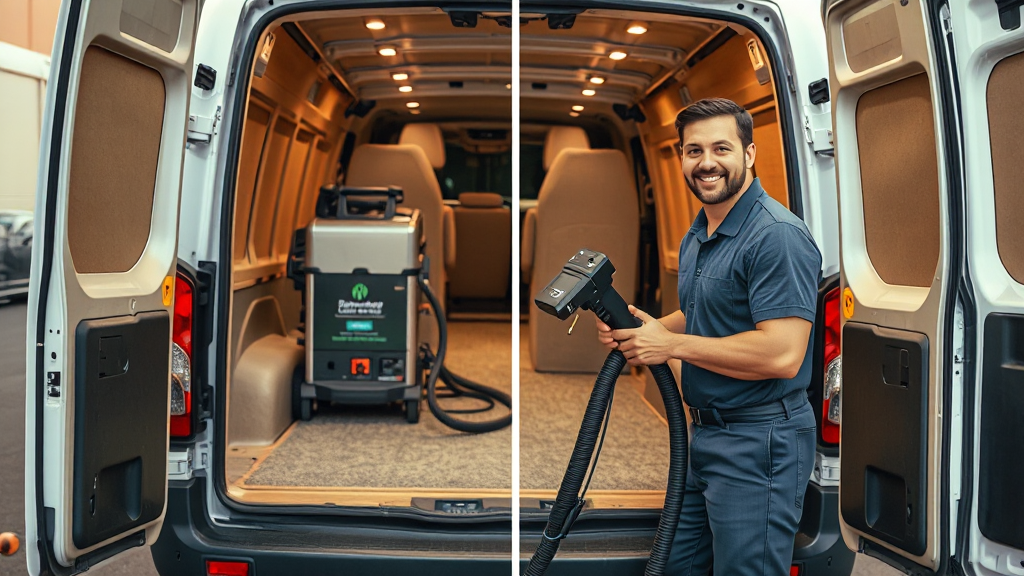
Equipment: Truck-Mount vs. Portable
The “you need a $30,000 truck mount to compete” myth stops more people than actual market conditions ever do. Here is the real breakdown:
Start with a mid-range portable in the $3,000–$6,000 range. At $175 or more per project and three projects a day, you recoup the equipment cost in a couple of weeks. Upgrade to a truck-mounted system only after you have consistent commercial contracts or five-plus daily residential bookings that justify it.
Where the Real Money Is: The Upsell Layer
Base carpet cleaning is profitable. The upsell layer is where margins climb highest, because the chemical cost of each add-on is a fraction of what you charge:
- Stain treatment — $25–$50 per spot (chemical cost: $2–$5).
- Protectant application — $30–$50 per room (cost: $5–$8).
- Deodorizing — $20–$40 per room (cost: $3–$6).
- Upholstery cleaning — $75–$150 per piece (cost: $5–$10).
- Tile and grout cleaning — $0.75–$1.50 per sq ft (cost: $0.10–$0.20 per sq ft).
Offered well, add-ons lift a typical project’s revenue by 50–75%. The key is to never pressure. Present them as clear options and let the client choose — clients who pick add-ons feel in control and rebook at higher rates. For a deeper look at protecting and growing your numbers as you scale, see our guide to maximizing profitability for contractors.
How to Start Lean Without Burning Cash
You do not need a truck mount or a marketing budget to launch profitably. A disciplined sequence keeps fixed costs low until revenue is steady:
- Buy a mid-range portable extractor ($3,000–$6,000) — skip the truck mount for now.
- Get insured immediately — general liability runs roughly $400–$800 a year and is non-negotiable.
- Set transparent per-room pricing — $50–$75 per room, with add-ons listed separately.
- Focus on your first reviews — your first ten five-star reviews shape your next hundred bookings.
- Add one upsell service per quarter — stain treatment first, then protectant, then upholstery.
Frequently Asked Questions
Is carpet cleaning a profitable business in 2026?
Yes. A solo carpet cleaning operator averaging three residential projects per day at $175 to $275 each can net $97,500 to $175,500 annually. Margins run 60 to 70% gross and 30 to 50% net, because chemical and equipment costs are low relative to project revenue.
How much does it cost to start a carpet cleaning business?
A lean start costs $3,000 to $6,000: a mid-range portable extractor, chemicals, general liability insurance, and basic marketing. Truck-mounted systems cost $15,000 to $35,000 but are unnecessary for residential work at launch.
How much should I charge per room for carpet cleaning?
Charge $50 to $75 per standard room. Hallways and stairs run $25 to $40 each. Add-ons like stain treatment ($25 to $50), protectant ($30 to $50 per room), and deodorizing ($20 to $40 per room) increase average project revenue by 50 to 75%.
Do I need a truck-mounted system to compete?
No. A quality portable extractor in the $3,000 to $6,000 range handles most residential work effectively. Truck-mounted systems offer faster extraction and stronger suction, but the return only makes sense after you have consistent commercial contracts or five-plus daily residential bookings.
Why does the $99 whole-house pricing model fail?
The advertised $99 rate relies on bait-and-switch upsells, so the real bill is two to three times higher. Clients feel deceived, leave one-star reviews mentioning hidden fees, and never rebook at full rates. Transparent flat-rate pricing of $175 to $275 per project is the sustainable model.
How does carpet cleaning compare to general house cleaning?
Carpet cleaning wins on revenue per hour, earning $100 to $175 versus $50 to $60 for general cleaning. General cleaning wins on repeat frequency, with monthly cycles versus every 6 to 12 months. The smartest operators run both, using carpet cleaning as the high-margin anchor.
How can I keep more of my carpet cleaning revenue?
Price with transparent flat rates, keep fixed overhead low until bookings are steady, and cut software sprawl by running quoting, scheduling, and invoicing through one tool instead of several. Every margin point not lost to inefficiency or middlemen stays in the business.