
More Paid to Franchises
Extra Cost per $400 Repair
Revenue Lost to Overhead
Homeowners who book a national franchise for a routine plumbing or HVAC call pay 30-50% more than those who book a local independent contractor for the same work, according to HomeAdvisor’s 2024 pricing data. On a $400 drain repair, that markup translates to $120-$200 in extra cost — money that pays for TV commercials, franchise royalties, and corporate management layers rather than the person actually fixing the problem.
On AllBetter
Need a local pro?
Post the job free and compare bids from identity-verified local pros — payment held in escrow until the work is done right.
Find a verified pro near you →Why are local contractors cheaper than big-box chains? Local mom-and-pop contractors operate with lower overhead because they do not pay franchise fees, national advertising costs, or corporate management salaries. Their pricing reflects the actual cost of labor and materials, not the cost of maintaining a national brand identity.
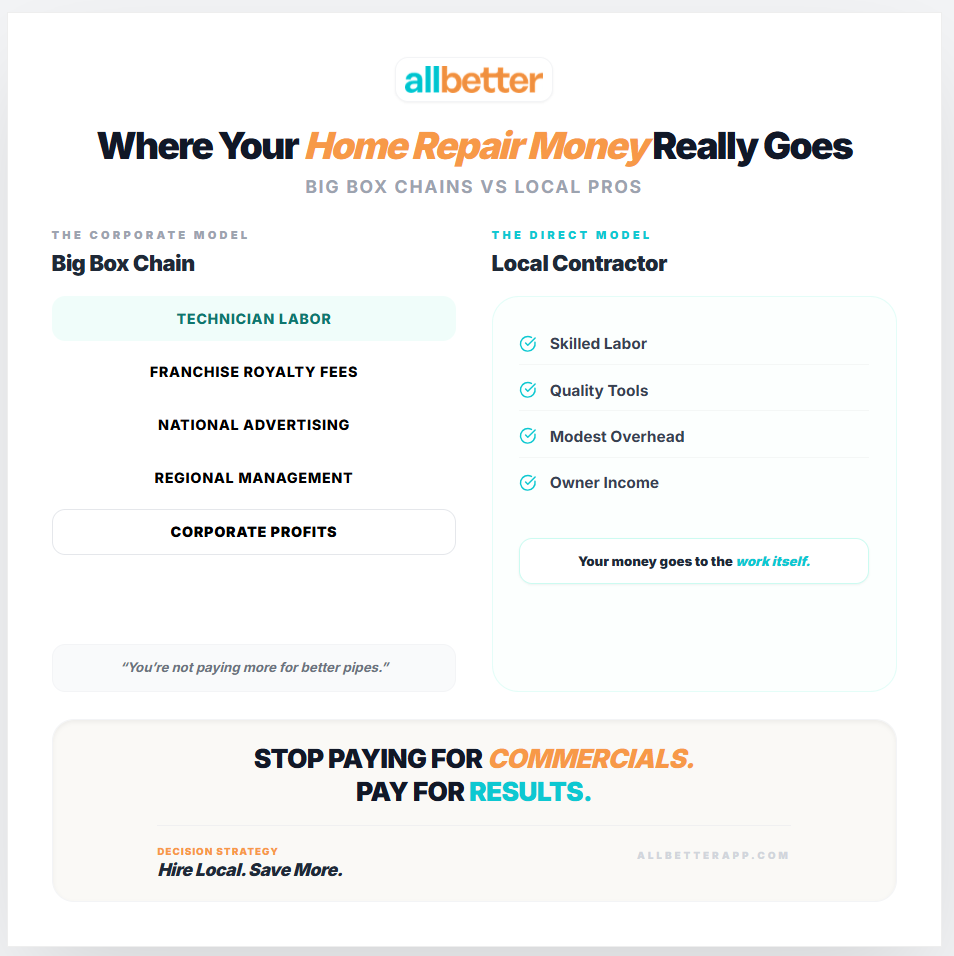
Where Your Money Actually Goes: Big Box vs. Local
Skipping the DIY route? You can post the job on AllBetter and have ID-verified pros bidding in about 10 minutes — no spam calls, payment held in escrow until you approve the work.
When you pay a national home service chain $500 for a repair, a significant portion of that bill never reaches the technician who did the work. According to the Small Business Administration (SBA), franchise businesses typically allocate 25-40% of revenue to franchise fees, national marketing funds, and corporate overhead.
of franchise revenue goes to fees, marketing, and corporate overhead — not your repair
Here is how the same repair breaks down depending on who you book:
| Cost Component | Big-Box Chain | Local Contractor |
|---|---|---|
| Technician labor | ~30% of bill | ~70-80% of bill |
| Marketing/advertising | 10-15% (national TV, digital) | Minimal (word of mouth, local) |
| Franchise/royalty fees | 5-8% of revenue | $0 |
| Corporate management | 10-15% (regional, HQ) | Owner-operated |
The difference is not about skill. The same technician who works for a franchise today often goes independent next year. When they do, their prices drop because the corporate overhead disappears. You get the same hands, the same tools, and the same experience at a lower price point.
The Middleman Tax: How Subcontracting Inflates Your Bill
Many national chains do not employ their own technicians at all. They operate as dispatchers, routing your service call to a local subcontractor and adding a markup layer on top.
The Bureau of Labor Statistics (BLS) reports that independent contractors in the home services sector earn a median hourly rate that is 20-35% lower than what franchise brands charge customers for the same work. The gap represents the middleman tax — a surcharge for brand recognition, not superior craftsmanship.
When you book a local contractor directly, you remove that intermediary. Your money goes to the professional performing the work, which creates a direct accountability loop that franchises cannot replicate.
Accountability: A Call Center vs. a Reputation

This is where the local advantage becomes most visible. When something goes wrong with a franchise repair, you call an 800 number, open a ticket, and wait. The technician who performed the work has limited personal stake in the outcome because they are employees rotating through assignments.
Local contractors operate differently. Their business is their reputation. Every review, every referral, and every callback directly affects their livelihood. A bad review for an independent plumber can cost them thousands in lost future bookings. A bad review for a franchise location gets buried in corporate response templates.
What this means in practice:
- Local contractors are more likely to return and fix issues at no additional charge
- Response times for warranty work are faster because the owner handles the call directly
- Relationship continuity means the same person who installed your water heater maintains it
For landlords managing tenant maintenance requests, this direct relationship is particularly valuable. You need someone who answers the phone, not a dispatch queue.
The Convenience Gap No Longer Exists
On AllBetter
Ready to get it done?
Fund escrow before work starts. Release payment when you approve the finished work.
Find a verified pro near you →For years, national chains held one legitimate advantage: convenience. They offered online booking, credit card payments, and digital receipts at a time when many local contractors operated on handshake agreements and cash.
That gap has closed. Platforms like AllBetter (a newer platform) now give independent contractors the same digital infrastructure that was once exclusive to franchises:
- App-based booking with clear project descriptions
- Secure digital payments with Escrow Shield protection
- Stripe Identity verification for every contractor
- Documented service history and communication logs
The result: local pricing with modern convenience. You no longer have to choose between the two.
The Skill Myth: Bigger Does Not Mean Better
Brand size creates a false impression of quality. The NAHB reports that the most experienced tradespeople in the residential sector are disproportionately self-employed or working in small firms of fewer than five employees. National chains, by contrast, often rely on junior technicians to control labor costs.
The pattern is consistent across trades. The best plumber in your zip code is likely not wearing a franchise uniform. They are running their own business, building a client base through quality work, and setting their own standards rather than following corporate protocols designed for volume.
When you book through a platform that connects you directly with local professionals, you access that tier of expertise without the franchise markup. The key is vetting — which is a solvable problem.
The 4-Point Local Contractor Vetting Checklist
The one valid concern about booking local is vetting. Franchises offer a baseline of standardization. Independent contractors require a few extra steps, but those steps are straightforward.
Step 1: Verify identity and credentials. Platforms with identity verification (like AllBetter’s Stripe Identity integration) handle this automatically. If booking independently, ask to see a government-issued ID and any relevant trade licenses.
Step 2: Confirm insurance coverage. Ask directly for proof of general liability insurance. Do not accept verbal assurance. According to the NAHB, approximately 20% of independent contractors carry insufficient coverage. This is the one area where diligence is non-negotiable.
Step 3: Review scope and pricing before work begins. Get a written quote that specifies materials, labor, timeline, and total cost. Any contractor who resists putting terms in writing is a red flag regardless of whether they are local or national.
Step 4: Use escrow-based payment. Never pay the full amount upfront. Escrow protects both parties and keeps the contractor accountable through completion. Learn why in why you should never pay a contractor upfront.
Why Local Booking Matters Even More for Landlords
For property owners, the financial case for booking local contractors strengthens with every unit. Landlords need repeat service relationships, fast response times, and predictable pricing. National chains rarely deliver on all three.
Landlord-specific advantages of local contractors:
- Faster response times because they operate in your area, not across a regional territory
- Lower per-project costs that compound across multiple units and turnovers
- Better tenant satisfaction from quicker repair completion
- Stronger long-term relationships that improve reliability over time
A local plumber who knows your property layout can diagnose issues faster than a franchise technician visiting for the first time. That efficiency translates directly into shorter repair windows and happier tenants. For a complete system for managing rental maintenance, see the landlord automation guide.
When Big-Box Chains Do Make Sense
Honest assessment requires acknowledging when franchises offer legitimate value. Large national brands can be the better choice in a few specific situations:
- Major system installations where manufacturer warranties require certified installers
- Insurance-backed projects where the homeowner’s insurance policy mandates a licensed, bonded company with specific coverage levels
- Emergency calls in unfamiliar areas where you have zero local contacts and need same-day service
For these scenarios, the franchise premium buys standardization and warranty backing that independent contractors may not match. But these situations represent a small fraction of total home service needs. The other 80-90% of residential repairs — drain clogs, fixture replacements, drywall patches, HVAC tune-ups — are handled better and cheaper by an ID-verified local professional.
How to Transition from Chain Dependence to Local Relationships
If you have been defaulting to national brands, the transition is simple. Start with a low-risk project — a handyman task under $300, for example. Book a local professional through a verified platform, evaluate the experience, and build from there.
Within three to four bookings, you will have a small roster of trusted local contractors who know your property and your standards. That roster becomes your most valuable asset as a homeowner or landlord, saving you thousands over time. Start by browsing handyman services near you or finding a plumber near you.
Stop Overpaying for Franchise Logos
Book ID-verified local contractors with Escrow Shield protection — your payment sits in escrow until you approve the work.
Hire local — verified, accountable, no lead-gen middleman
| Feature | Angi / Thumbtack / HomeAdvisor | AllBetter |
|---|---|---|
| Pro Identity Verified | Self-attested, no verification | Stripe Identity verification on every pro |
| Lead Fees to Pros | $15–$80 per lead (passed back to homeowner) | only pay when you win |
| Payment Protection | None — you pay direct, hope for the best | Escrow Shield — you only release payment when work is approved |
| Pro Quality Filter | Anyone can sign up; reviews come later | ID-verified pros, average 3+ bids per job |
| Spam & Auto-Calls | Your phone rings for days after one inquiry | Zero spam — pros message in-platform |
Lead-fee context for this job type: big-box service desks (Home Depot, Lowe’s) outsource installs to subcontractors who pay franchise fees — AllBetter is direct, only pay when you win.
Big-box install programs route the work to subcontractors you didn’t choose — quality varies, callbacks bounce between three customer-service queues, and accountability evaporates. The safer move is to see how AllBetter works — you get ID-verified bids in minutes, no obligation.
Your money sits in escrow and is released only when you approve the work.
Frequently Asked Questions
How do I find local contractors in my area?
The fastest way to find local contractors in your area is to post your project free on AllBetter — every contractor is Stripe Identity-verified, your zip code routes the job to local pros only, and your payment is held in escrow until the work passes inspection. No more random Google ads or big-box marketing budgets inflating your quote. Post your project free and compare 3 competing bids from neighborhood contractors in 10 minutes.
Find local contractors in my area →
Are big-box home service contractors more reliable than local ones?
Not inherently. Many national chains subcontract work to local professionals and add a markup. The technician may be identical whether you book through a franchise or directly. Reliability depends on individual vetting, not brand size.
Is booking a local contractor riskier than using a franchise?
Only if you skip basic checks. Verifying identity, confirming insurance, getting written quotes, and using escrow-based payment eliminates most risk. Platforms like AllBetter automate the identity verification step through Stripe Identity.
Why are big-box home service companies more expensive?
Their pricing includes franchise royalties (5-8% of revenue), national advertising budgets, regional management salaries, and corporate profit layers. These costs get passed to the customer without improving the quality of the repair itself.
Can local contractors handle complex projects like HVAC installation or electrical panel upgrades?
Yes. Many independent contractors are licensed masters with decades of experience. The most skilled tradespeople often leave franchise systems to work independently, bringing their expertise to a lower-overhead business model.
How do I verify that a local contractor has proper insurance?
Ask directly for a Certificate of Insurance (COI) showing active general liability coverage. Do not accept verbal confirmation. A legitimate contractor will provide this document without hesitation. If they resist, move on.
Do local contractors offer warranties on their work?
Many do, though terms vary. Ask about warranty coverage before work begins and get it in writing. Escrow-based platforms add an additional layer of protection by holding payment until the work is verified as complete.
What is the best way to find ID-verified local contractors in my area?
Use a platform that provides identity verification and payment protection rather than relying on directory listings alone. AllBetter verifies every contractor through Stripe Identity and holds payments in escrow. Alternatively, ask neighbors, local real estate agents, or your property manager for referrals to contractors with proven track records.
Download AllBetter App Now – Android | iOS
Every contractor on AllBetter passes Stripe Identity verification and your payment is held in Escrow Shield protection — your payment sits in escrow until you approve the work.
Related: How to Choose the Right Contractor | Essential Home Maintenance Skills | Hidden Costs of Homeownership
According to FTC Consumer Advice — Hiring a Contractor, FTC guidance: direct relationships with licensed local contractors give homeowners stronger recourse than reseller / installer-network arrangements.
More AllBetter resources you may find useful: