
On AllBetter
Need an HVAC pro?
Post the job free and compare bids from identity-verified local pros — payment held in escrow until the work is done right.
Find an HVAC pro near you →Nearly every forced-air home in the northern half of the country heats with gas, and every gas-furnace quote is really three stacked decisions: how many BTUs, which efficiency tier, and how much staging. Our furnace replacement guide covers the whole market — fuel types, brands, the install process. This page does the gas-only math, decision by decision.
How much does a gas furnace cost? A new gas furnace costs $2,500–$6,500 installed for most homes in 2026. The efficiency tier is the biggest lever you control: a standard 80% AFUE unit sits at the bottom of the range, while jumping to a 95–98% condensing model typically adds $1,000–$2,500 — and duct modifications or venting changes can push a complex job toward $7,800.
Gas Furnace Cost by Efficiency Tier
| Tier | Typical 2026 installed cost | What you’re buying |
|---|---|---|
| 80% AFUE, single-stage | $2,500–$4,500 | The workhorse: metal-flue venting, simplest install |
| 80% AFUE, two-stage | $3,000–$5,000 | Quieter, steadier heat; same venting |
| 95–98% AFUE condensing | $3,500–$6,500 | PVC venting + condensate drain; lowest gas bills |
| 97%+ modulating, premium | $5,000–$6,500+ | Continuous flame adjustment; qualifies for federal credits |
The tiers are not just sticker prices — they change the install itself. An 80% furnace vents through the existing metal flue; a condensing furnace extracts so much heat that its exhaust leaves as low-temperature vapor through new PVC pipes, with a condensate drain that has to go somewhere. That venting work is part of why the efficiency jump costs what it does, per the U.S. Department of Energy’s furnace and boiler guidance. In cold climates the jump pays back in 3–7 winters of gas savings; in mild climates it may never.
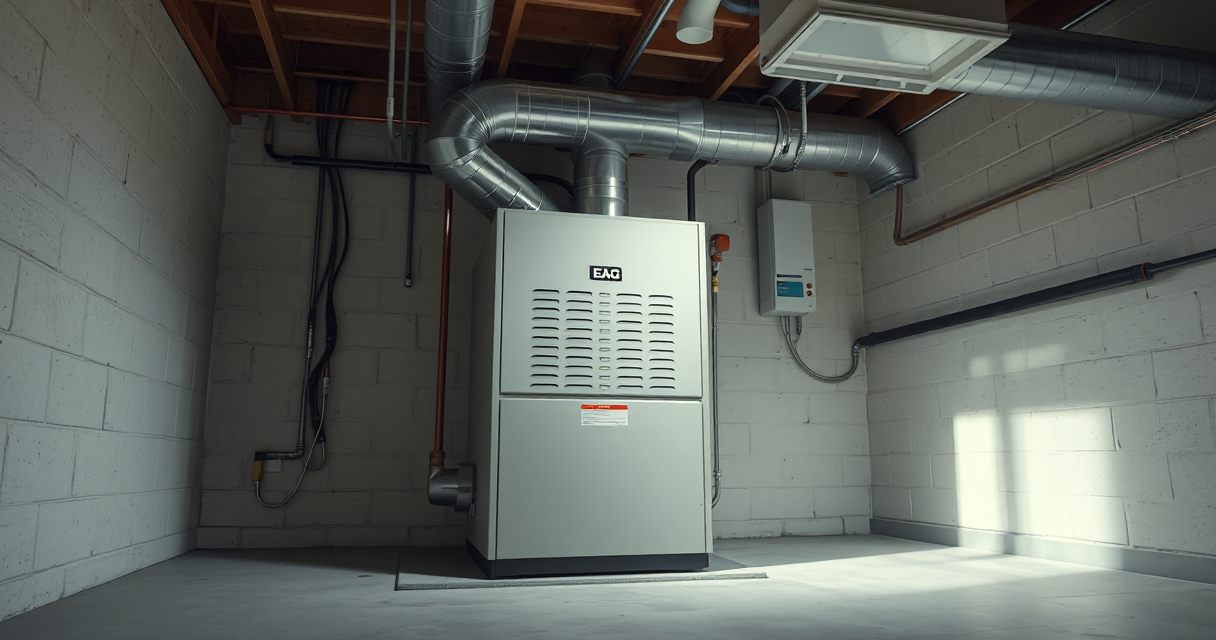
Gas Furnace Cost by Home Size (BTU)
On AllBetter
Ready to get it done?
Fund escrow before work starts. Release payment when you approve the finished work.
Find an HVAC pro near you →Furnace capacity is sold in BTU output, and the right number comes from an ACCA Manual J load calculation — insulation, windows, climate, and layout — not from matching the old unit’s label. As rough context only, smaller homes typically land on 40,000–60,000 BTU units at the lower end of the installed range, mid-size homes on 60,000–80,000 BTU in the middle, and large or leaky homes on 90,000–120,000 BTU units toward the top. The pricing pattern is simple: the equipment steps up modestly with size, and the range within any size is still driven mostly by the efficiency tier above.
Oversizing is the classic mistake — and the expensive one. A too-big furnace short-cycles: it slams to temperature, shuts off, and repeats, which wears the heat exchanger, leaves rooms uneven, and burns more gas than a right-sized unit running steady. If a bid names a BTU size without measuring anything, that’s a bid to discard.
What Else Moves the Price
- Venting conversion: going from 80% to condensing means new PVC intake/exhaust runs and a condensate drain — simple on an exterior wall, more when the furnace sits deep in the house.
- Ductwork condition: failing or undersized ducts add $1,000–$3,000 and quietly cancel the efficiency you just bought if skipped.
- Federal credits: qualifying 97%+ AFUE gas furnaces earn up to $600 under the Inflation Reduction Act — check current eligibility on ENERGY STAR’s furnace pages and confirm with your tax professional before counting on it.
- Timing: early fall and late spring get you the sharpest bids; January emergencies pay premiums. If the furnace is limping rather than dead, price the repair first — and if the AC is also past 10 years, run the combo bundle math before paying for two separate installs.
Is the Condensing Upgrade Worth It?
Honest answer: it depends on your winters. Every dollar of gas an 80% furnace burns delivers 80 cents of heat; a 96% unit delivers 96 cents. In a cold-climate home with real heating bills, that 16-point spread typically repays the $1,000–$2,500 premium in 3–7 years, then keeps paying for the rest of a 15–20-year service life. In a mild climate where the furnace runs six weeks a year, the payback may never arrive — put the money toward better insulation instead. A useful tiebreaker: if you are also weighing whole-system options, the HVAC replacement guide compares gas furnaces against heat pumps head-to-head, and the HVAC hub holds the rest of the series.
Not sure the furnace is actually done? Price the fix first — our HVAC repair cost guide prices every common furnace and AC fix so you can run the repair-vs-replace math with real numbers.
Gas Furnace Cost FAQ
Where these numbers come from: ranges are the gas-furnace slice of the installed ranges in our furnace and HVAC replacement guides — standard residential pricing across U.S. metros in 2026 — with the efficiency-tier spread reflecting the documented $1,000–$2,500 AFUE premium; efficiency and credit guidance from the U.S. Department of Energy and ENERGY STAR. Every install prices to its own scope — compare itemized bids with Manual J sizing shown.
How long does a gas furnace last?
15–20 years with annual service. Past year 15, budget for replacement at the first major repair rather than after the third.
Why is my quote higher than the furnace’s online price?
The box is roughly half the job. Removal and disposal, venting work, gas-line and electrical connections, code items, permits and commissioning make up the rest — which is why installed ranges, not equipment prices, are the numbers worth comparing.
Is a two-stage furnace worth it over single-stage?
For comfort, usually — steadier temperatures and less blast-furnace cycling for a modest premium. For pure economics, the AFUE tier matters far more than staging.
Do I need a new thermostat with a new gas furnace?
Often, especially moving to two-stage or modulating equipment that older thermostats can’t control properly. Budget $75–$300 for a compatible unit if it isn’t in the bid.