
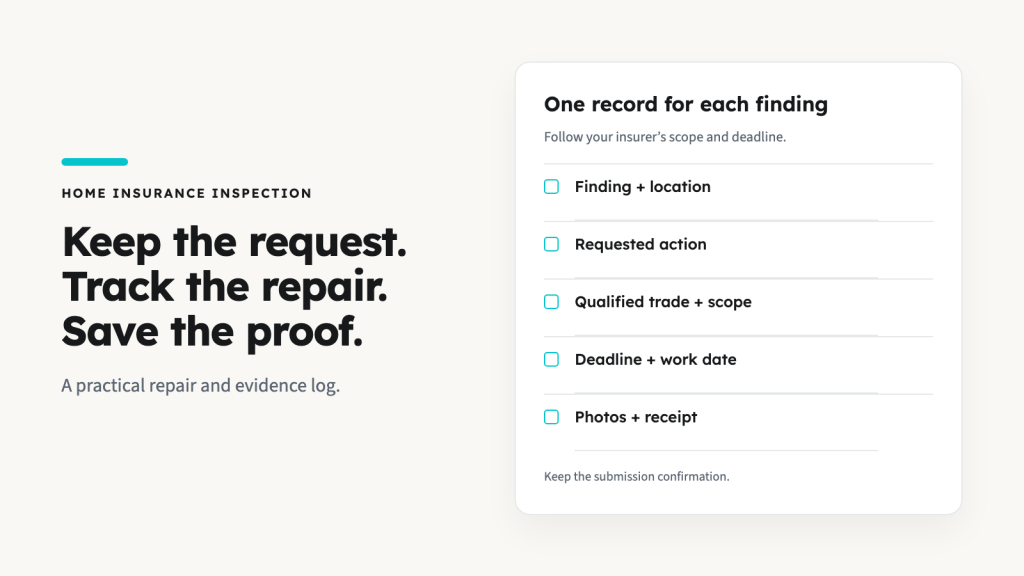
Start a home insurance inspection checklist with the insurer’s actual request. Record what must be inspected, what access or photos are needed, and any response deadline. Then track each finding through assessment, a written repair scope and the evidence requested by your insurer.
On AllBetter
Need a local pro?
Post the job free and compare bids from identity-verified local pros — payment held in escrow until the work is done right.
Find a verified pro near you →This guide is for an existing homeowner managing an insurer’s inspection or repair request. If you are deciding whether to buy a property, use the buyer’s home inspection checklist instead. Neither checklist determines what a policy covers.
- 1 · Confirm Who Requested the InspectionCheck the sender, requested proof and deadline.
- 2 · Prepare Access and Existing RecordsConfirm access and gather records you already have.
- 3 · Record Findings Without Diagnosing ThemUse the finding’s actual wording and location.
- 4 · Obtain a Clear Repair ScopeSeparate diagnosis, repair and restoration in writing.
- 5 · Keep a Repair and Evidence LogMatch photos and documents to each request.
- 6 · Submit the Requested Proof and Confirm ReceiptRecord receipt and anything still outstanding.
1. Confirm Who Requested the Inspection
On AllBetter
Ready to get it done?
Fund escrow before work starts. Release payment when you approve the finished work.
Find a verified pro near you →Read the notice before arranging work. Verify unfamiliar requests through your insurer’s established contact channel. Ask whether the request is for an exterior inspection, an interior visit, a specialist report or photographs you submit yourself.
Progressive’s inspection guide explains that insurer inspections can differ in scope and that the results may affect a policy. Your insurer’s own instructions control the evidence and response it needs.
- Insurer and reference number: ____________________
- Requested inspection or document: ____________________
- Named contact and verified contact method: ____________________
- Appointment, access needs and response deadline: ____________________
2. Prepare Access and Existing Records
Confirm how the inspector will enter and which areas need to be accessible. Gather records you already have that match the request, such as prior repair invoices, equipment information or a requested specialist report. Ask before purchasing an additional inspection whose format may not meet the insurer’s needs.
Do not climb onto a roof, open electrical equipment or enter unsafe spaces to complete the checklist. Ask what alternative documentation is acceptable when a requested view is unsafe or inaccessible.
3. Record Findings Without Diagnosing Them
Use the insurer’s or inspector’s wording and include the location. “Staining on the ceiling below the bathroom” records an observation; “failed pipe” claims a cause that may still need diagnosis. Ask which findings require professional evaluation and which require a specific repair or document.
For moisture-related findings, the water-damage assessment questions help separate the source of moisture from cosmetic repair. For a damaged deck, review the deck warning signs and professional assessment scope; do not test a suspect structure yourself.
If you see a possible immediate hazard, follow the relevant emergency service or utility’s instructions. The insurance deadline is not a reason to delay addressing an active safety problem.
4. Obtain a Clear Repair Scope
Give the professional the relevant finding and ask for a written assessment and scope. Keep diagnosis, repair, access and restoration separate so you can see what the quote actually covers. Confirm licensing, permits and qualifications for the exact work.
The FTC’s contractor-hiring guidance recommends written estimates that identify the work, materials, completion date and price. Verify the contractor’s license with the relevant state or county authority and request proof of insurance.
For plumbing or electrical findings, start with an appropriate plumbing professional or electrical professional, then verify the required credentials. Marketplace identity verification is a separate check.
Keep the insurer’s response deadline separate from your funding plan. Use the home maintenance budget worksheet to organize assessed repair costs; a savings schedule does not change the insurer’s deadline.
5. Keep a Repair and Evidence Log
Use one record for each requested item. The filled example below is fictional: its wording and documents illustrate the workflow, not what your insurer will accept.
Request
Item A: staining below the bathroom. The notice asks for an assessment and repair documentation. Copy the actual deadline from the notice; the cause is not yet established.
Assessment and scope
A qualified plumbing professional assesses the source. Keep the written diagnosis and authorized repair together; list ceiling restoration separately.
Evidence folder
Save the requested report, repair invoice and safely taken photos as “Item A.” Add any permit or completion document required for the work.
Response
Record when and how you submitted the documents. Keep the receipt, then ask whether anything else is needed. A receipt is not an acceptance decision.
Open a blank repair record
Type into this worksheet, then copy your entries into your own document before leaving the page. This worksheet has no submit or save function. Do not enter policy numbers, access codes or other sensitive information.
A paid receipt shows a payment, not necessarily the exact work or the insurer’s acceptance. Keep the scope, completion record and any required permit or inspection documentation together.
6. Submit the Requested Proof and Confirm Receipt
Follow the notice’s stated method and deadline. Label each attachment with the finding it addresses. Keep a copy of what you sent and the confirmation. If work cannot be completed on time, contact the insurer promptly and request written instructions; do not assume an extension.
Ask whether the submission is complete and whether anything remains outstanding. Repair completion does not itself guarantee coverage, renewal, a lower premium or acceptance. Direct policy questions to your insurer or qualified adviser.
The NAIC’s homeowners insurance guidance explains that the policy sets out the homeowner’s and insurer’s responsibilities. Keep your policy and notice together, and ask the insurer to explain requirements you do not understand.
For ongoing care after this request is resolved, add the professional’s recommendations to your system-by-system home maintenance plan. Keep routine reminders separate from unresolved insurer requests.
Before You Book the Repair
Use one defined scope to compare quotes. On AllBetter, posting and comparing bids is free — a small service fee applies when you book, covering escrow payment protection. Check the professional’s relevant license and qualifications separately and keep insurer requirements in the written scope.
Sources and Further Reading
- Progressive: home insurance inspections — inspection purpose, scope and possible policy effects.
- FTC: avoiding home improvement scams — licensing checks, written estimates and contract review.
- NAIC: homeowners insurance — reading the policy and understanding responsibilities.
Written by Tarik Khribech, founder of AllBetter. Reviewed October 8, 2026.