
American homeowners spend an average of $650 to $1,500 per window on full replacements according to the U.S. Department of Energy, yet many window problems can be resolved for under $300. The window replacement industry generates billions annually by encouraging full replacements when targeted repairs would solve the issue at a fraction of the cost. Understanding the difference between a repairable problem and a genuine replacement scenario can save thousands across a typical home with 15 to 20 windows.
On AllBetter
Need a handyman?
Post the job free and compare bids from identity-verified local pros — payment held in escrow until the work is done right.
Find a handyman near you →typical window repair cost
full window replacement per unit
to recoup replacement via energy savings
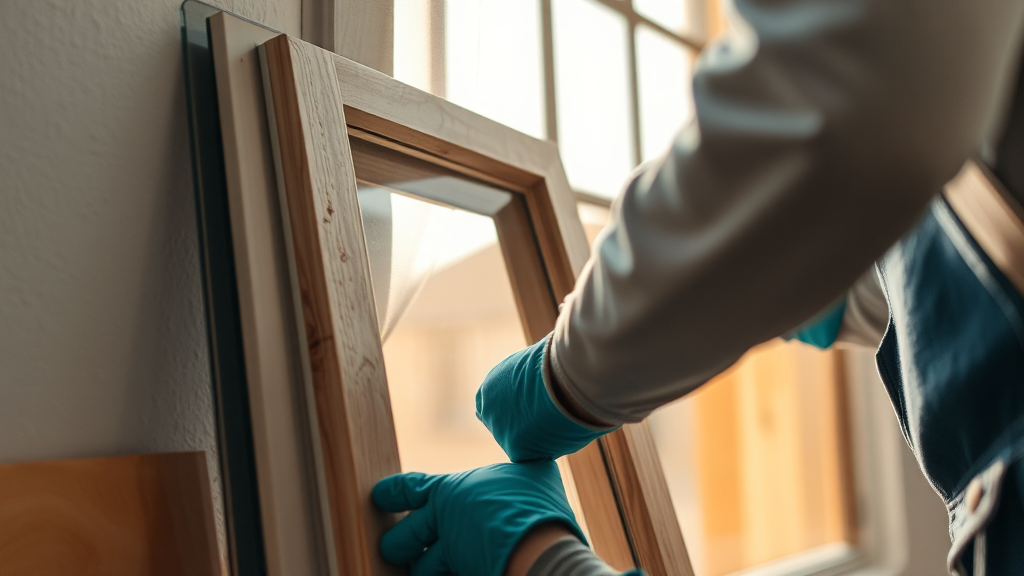
What is window repair vs. replacement? Window repair involves fixing specific components (glass units, seals, hardware, weatherstripping) while keeping the existing frame intact. Window replacement means removing the entire window assembly and installing a new unit. Repair is typically appropriate when the frame is structurally sound; replacement is necessary when the frame itself is compromised.
This guide covers the most common window failures, explains which ones genuinely require replacement, and provides the cost context to help you make an informed decision rather than an emotional one driven by a sales pitch.
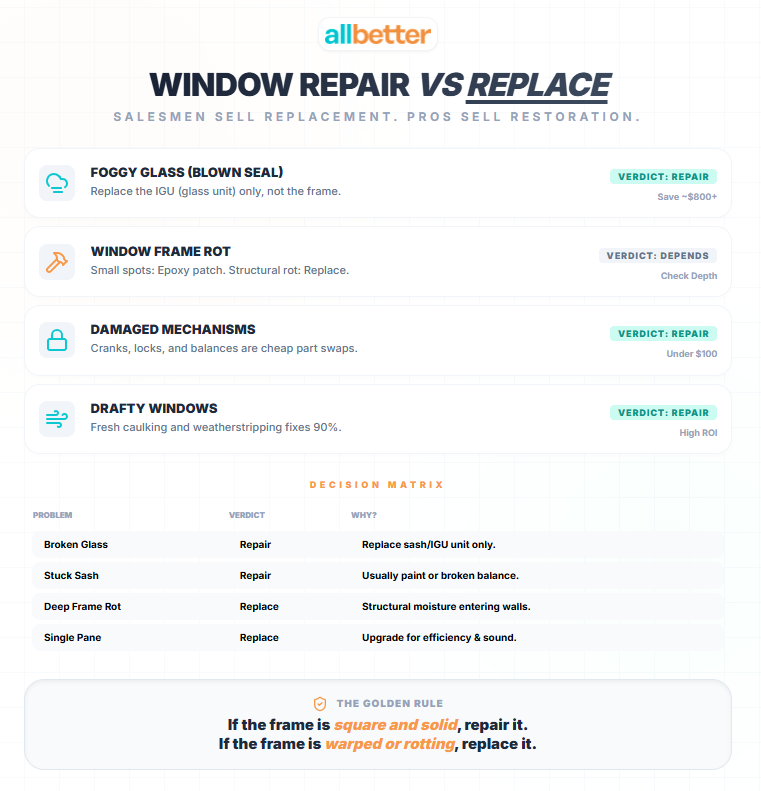
The Real Cost Gap Between Repair and Replacement
Watch: real window replacement numbers, before the sales pitch (39 seconds).
Skipping the DIY route? You can post the job on AllBetter and have ID-verified pros bidding in about 10 minutes — no spam calls, payment held in escrow until you approve the work.
According to the National Association of Home Builders (NAHB), window replacement is one of the home improvements with the longest payback periods. Energy savings from new windows typically run 10 to 15 percent on heating and cooling bills, which means a $15,000 to $25,000 whole-house window replacement might take 25 to 40 years to recoup through utility savings alone. By contrast, targeted repairs address the specific failure point and preserve the investment already embedded in your existing windows.
The Bureau of Labor Statistics (BLS) reports that glaziers and window specialists earn between $40 and $70 per hour, which means a focused repair visit typically costs $150 to $400 in labor. Compare that to $650 to $1,500 per window for full replacement including materials and installation. When the frame is solid and the problem is isolated, repair delivers a dramatically better return.
Foggy Glass: The Most Common (and Most Repairable) Problem
If you see moisture or haze trapped between the two panes of a double-pane window, you have a failed seal. The argon or krypton gas that once filled the space between panes has escaped, and ambient moisture has taken its place. This is called a “blown seal,” and it is one of the most common window complaints.
Why this is almost always a repair
A blown seal does not mean the window frame, hardware, or weatherstripping has failed. Only the insulated glass unit (IGU) needs replacement. A glass specialist or experienced handyman can measure the existing frame, order a replacement IGU, and install it without disturbing the surrounding wall or trim.
Typical IGU replacement costs $200 to $450 per window depending on size and glass type (Low-E, argon-filled, etc.). Full window replacement for the same issue would cost $800 to $1,500. The frame remains perfectly functional, and the new glass unit restores full insulating performance.
Damaged Frames: When Repair Works and When It Does Not
Window frames endure decades of sun exposure, rain, temperature cycling, and physical stress. The material matters significantly when evaluating damage:
Wood frames
Wood is the most repairable frame material. Small rot spots on sills and lower rails can be excavated, filled with structural epoxy, sanded smooth, and painted. A skilled handyman or carpenter can make an epoxy repair that is structurally stronger than the original wood. This type of repair typically costs $100 to $300 per window.
However, if rot has penetrated through the frame to the wall studs, or if the frame is visibly warped and no longer square, the structural integrity is compromised. Water is likely entering the wall cavity, creating mold risk. In this scenario, full replacement is the correct choice. Learning to spot these issues early is one of the essential home maintenance skills every homeowner should develop.
Vinyl frames
Vinyl does not rot, but it can crack, warp from heat exposure, or become brittle over time. Minor cosmetic damage can sometimes be patched, but cracked vinyl frames that are leaking water or air generally need replacement because vinyl cannot be structurally rebuilt the way wood can.
Aluminum frames
Aluminum frames are durable but prone to condensation. They rarely need structural replacement, though homeowners in cold climates sometimes upgrade for better insulation.
Hardware Failures: Almost Never a Reason to Replace
Windows contain mechanical components that wear out independently of the frame and glass. Sash balances (the springs or weights that hold a window open), crank operators (on casement windows), locks, and latches are all replaceable parts. The BLS classifies these as maintenance items rather than replacement indicators.
Common hardware problems and their fixes
- Window slams shut when released: Broken sash balance. Replacement cost: $15 to $40 per balance plus labor.
- Casement window will not crank open: Failed crank operator. Replacement cost: $20 to $60 for the part.
- Window will not lock: Worn latch mechanism. Replacement cost: $10 to $30.
- Double-hung window stuck closed: Often paint buildup between sash and frame. A handyman can score the paint line, free the sash, and clean the track in under an hour.
The critical point: never replace an $800 window because of a $40 hardware failure. These are among the costly mistakes homeowners make when they do not understand window anatomy.
Drafty Windows: Weatherstripping Before Replacement
On AllBetter
Ready to get it done?
Fund escrow before work starts. Release payment when you approve the finished work.
Find a handyman near you →Feeling a breeze when a window is closed is uncomfortable, but it is rarely a reason for full replacement. The most common causes of air infiltration are deteriorated weatherstripping and cracked caulking around the frame perimeter. Both are inexpensive repairs.
A handyman can remove old brittle caulk and apply a fresh bead around the exterior frame in about 30 minutes per window. Interior weatherstripping (V-seal, foam tape, or felt strips along the sash channels) adds another layer of air sealing. Total material cost for weatherstripping a single window is typically $5 to $15.
The one exception: single-pane windows. If your home still has original single-pane glass, no amount of weatherstripping will match the thermal performance of modern double-pane units. Single-pane to double-pane is one of the few window upgrades where replacement genuinely makes financial sense over time, especially in climates with extreme temperatures.
The Repair vs. Replace Decision Matrix
Use this table for a quick assessment of common window problems:
| Problem | Verdict | Reason |
|---|---|---|
| Foggy or cloudy glass | Repair | Replace the IGU only; frame is unaffected |
| Broken glass pane | Repair | Replace sash or glass unit; frame intact |
| Stuck sash | Repair | Paint buildup or broken balance; easy fix |
| Minor sill rot | Repair | Epoxy fill, sand, and paint |
| Deep frame rot | Replace | Water likely entering wall; mold risk |
| Single-pane glass | Replace | Upgrade to double-pane for efficiency |
| Hardware failure | Repair | Replacement parts are inexpensive |
The golden rule: if the frame is square and structurally solid, repair it. If the frame is warped, rotted through, or allowing water into the wall cavity, replace it. This simple test correctly identifies the right path in the vast majority of cases.
Finding a Repair-Focused Professional
One of the challenges with window repair is finding a professional who actually wants to do the work. Large window companies make their revenue from full replacements and have little incentive to offer repair services. Their in-home estimates are often structured as sales presentations rather than diagnostic assessments.
Independent handymen, glaziers, and small window service companies are typically the best fit for repair work. They specialize in solving specific problems rather than selling full-system replacements. When choosing the right handyman for window work, look for experience with glass replacement, weatherstripping, and hardware sourcing.
Platforms like AllBetter connect homeowners with tradespeople for specific repair tasks, though coverage depends on your area. The direct-to-tradesperson model avoids the replacement-focused sales process that dominates the window industry.
Energy Efficiency: The Numbers Behind the Sales Pitch
Window replacement companies frequently lead with energy savings as the primary justification. The numbers deserve scrutiny. According to the U.S. Department of Energy, replacing single-pane windows with Energy Star double-pane units saves $126 to $465 per year. For a home with 15 windows at $1,000 each, the payback period stretches to 32 to 119 years through energy savings alone.
Average energy savings from replacing single-pane with double-pane windows (DOE). At $15K–$25K for whole-house replacement, the payback takes 32 to 100+ years.
The renovations with the best ROI tend to be targeted improvements rather than whole-system replacements. If energy efficiency is your primary concern, start with weatherstripping, caulking, and window film before considering full replacement.
Window Lifespan by Material
The NAHB publishes expected lifespan data for residential windows: wood windows last 50+ years with maintenance, vinyl windows 20 to 40 years (quality varies significantly by manufacturer), aluminum windows 20 to 30 years, and fiberglass windows 30 to 50 years. A regular home maintenance schedule that includes annual inspections, caulking, and hardware lubrication extends the functional life of any window type.
Is it worth repairing 20-year-old windows?
It depends on the window quality. High-quality wood or premium vinyl windows from 20 years ago are often worth repairing because they were built with better materials and craftsmanship. Cheap builder-grade vinyl windows from the same era may be nearing end of life with brittle frames and degraded seals. Evaluate the frame condition rather than relying on age alone.
Can a handyman fix a broken window seal?
A handyman cannot repair the seal itself, but they can measure the existing frame, order a replacement insulated glass unit (IGU), and install it. This effectively solves the foggy glass problem by replacing the sealed glass assembly. The process typically costs $200 to $450 per window, compared to $800 to $1,500 for full window replacement.
How much does it cost to replace just the window glass?
For a standard double-hung window, replacing the insulated glass unit typically costs between $200 and $450, depending on size and glass specifications (Low-E coating, argon fill, etc.). Larger windows and specialty glass types cost more. This price includes the glass unit and professional installation.
Do new windows really pay for themselves in energy savings?
Rarely through energy savings alone. The U.S. Department of Energy estimates annual savings of $126 to $465 from replacing single-pane windows with double-pane units. At typical replacement costs of $15,000 to $25,000 for a whole house, the payback period ranges from 32 to over 100 years. Repair combined with weatherstripping and caulking often delivers better financial returns.
What is the average lifespan of a residential window?
Vinyl windows last 20 to 40 years, wood windows can last 50 or more years with proper maintenance, aluminum windows last 20 to 30 years, and fiberglass windows last 30 to 50 years. Quality, climate exposure, and maintenance frequency all affect actual lifespan significantly.
Should I replace all my windows at once or one at a time?
If only a few windows have problems, replace or repair those individually. Whole-house replacement makes sense only when the majority of windows are failing simultaneously, typically in homes with original builder-grade windows reaching end of life. Addressing problems individually spreads cost over time and avoids paying to replace functional windows.
How do I know if my window frame is too damaged to repair?
Check three things: Is the frame square (measure diagonals)? Is there soft, crumbling wood that goes deeper than a quarter inch? Is there evidence of water damage on the interior wall below the window? If the frame is out of square, deeply rotted, or causing interior water damage, replacement is the safer choice. Surface-level damage on an otherwise square and solid frame is repairable.
Need a window repair or replacement quote?
AllBetter connects homeowners with verified glaziers, handymen, and window specialists — with escrow payment protection built in. Post your window project and compare quotes from local pros.
Assess Before You Spend
The window replacement industry benefits from homeowner uncertainty. When a window fogs, sticks, or lets in a draft, the immediate instinct is to call a window company, and window companies sell windows. By understanding the anatomy of common window problems, you can identify which issues are simple repairs and which genuinely require new units. In most cases, the answer is repair, and the savings are substantial.
Get an ID-verified handyman to assess your windows — before you spend $1,200/window
| Feature | Angi / Thumbtack / HomeAdvisor | AllBetter |
|---|---|---|
| Pro Identity Verified | Self-attested, no verification | Stripe Identity verification on every pro |
| Lead Fees to Pros | $15–$80 per lead (passed back to homeowner) | only pay when you win — ever |
| Payment Protection | None — you pay direct, hope for the best | Escrow Shield — you only release payment when work is approved |
| Pro Quality Filter | Anyone can sign up; reviews come later | ID-verified pros, average 3+ bids per job |
| Spam & Auto-Calls | Your phone rings for days after one inquiry | Zero spam — pros message in-platform |
Lead-fee context for this job type: medium — window installers on traditional sites pay $30-$60 per lead, which inflates your replacement quote.
Misdiagnosing rotted sills as cosmetic damage means you re-paint over an active moisture problem — three years later the entire frame fails and you’re paying for full replacement plus drywall and insulation remediation. The safer move is to post a window inspection job on AllBetter — you get ID-verified bids in minutes, no obligation.
Your money sits in escrow and is released only when you approve the work.
Frequently Asked Questions
Can foggy double-pane windows be repaired without full replacement?
Yes. A glazier can measure the existing frame, order a replacement insulated glass unit (IGU), and install it. This costs $200 to $450 per window versus $800 to $1,500 for full replacement.
How much does it cost to replace just the window glass?
For a standard double-hung window, replacing the insulated glass unit typically costs $200 to $450, depending on size and glass specifications. This includes the glass unit and professional installation.
Do new windows really pay for themselves in energy savings?
Rarely through energy savings alone. The DOE estimates annual savings of $126 to $465 from replacing single-pane with double-pane. At $15,000 to $25,000 for a whole house, the payback ranges from 32 to over 100 years. Repair combined with weatherstripping often delivers better returns.
What is the average lifespan of a residential window?
Vinyl windows last 20 to 40 years, wood windows 50+ years with maintenance, aluminum 20 to 30 years, and fiberglass 30 to 50 years. Climate exposure and maintenance frequency significantly affect lifespan.
Should I replace all my windows at once or one at a time?
If only a few have problems, repair or replace those individually. Whole-house replacement only makes sense when the majority are failing simultaneously. Addressing problems individually spreads cost over time.
How do I know if my window frame is too damaged to repair?
Check three things: Is the frame square (measure diagonals)? Is there soft, crumbling wood deeper than a quarter inch? Is there water damage on the interior wall below? If the answer is yes to any, replacement is safer.
According to Energy.gov — Update or Replace Windows, in many cases improving existing windows (storm windows, weatherstripping, caulking) costs a fraction of replacement and captures most of the energy savings.
More AllBetter resources you may find useful: